



























BUILD YOUR OWN
RESOURCE LIBRARY



Martha’s Vineyard Transit Authority launches microgrid
The microgrid aims to establish a resilient, independent energy source using on-site solar power and battery energy storage for its growing fleet of electric buses.


The microgrid combines on-site solar and battery storage Image courtesy: VTA/Arup
Martha’s Vineyard Transit Authority (VTA) has launched a renewable energy microgrid, which uses on-site solar power and battery energy storage to power its growing fleet of electric buses.
According to VTA, the microgrid establishes a “resilient, independent energy source” while significantly reducing carbon emissions of the public transportation network for Martha’s Vineyard Island, off the coast of Massachusetts.
Electrified bus system
It reports the new electrified bus system will eliminate 36,000 tons of carbon dioxide over 10 years of more than 10 years of driving 1.4 million miles annually.
The single-user microgrid, designed by Arup, PXiSE and Vermont Energy Investment Corporation, is an energy distribution, storage, and generation network that can be disconnected from the main grid during power outages to then tap into its own stored electricity and solar-generated power.
This system also allows the agency to reduce its demand on the grid during peak hours and enables it to charge vehicles overnight through its energy storage infrastructure without interrupting service.
Martha’s Vineyard, an island of about 100 square miles off the coast of Massachusetts, presents a prototypical challenge for public transportation. Accessible by boat and air only, the island depends on imported fossil fuels for electricity and to power vehicles.
“Our overriding priority is to provide a fleet that will serve the island for years to come with buses that are the most reliable, emission-free, fuel-saving vehicles available”
This not only translates into higher fuel and energy costs, but it also contributes to greenhouse gas emissions and leaves the island vulnerable to power outages during a major weather event. Seeing the promise of electrifying its bus fleet, in 2018 the VTA began to transition from diesel to battery electric vehicles to better serve its 17,000 year-round residents who live in six towns connected by the bus service.
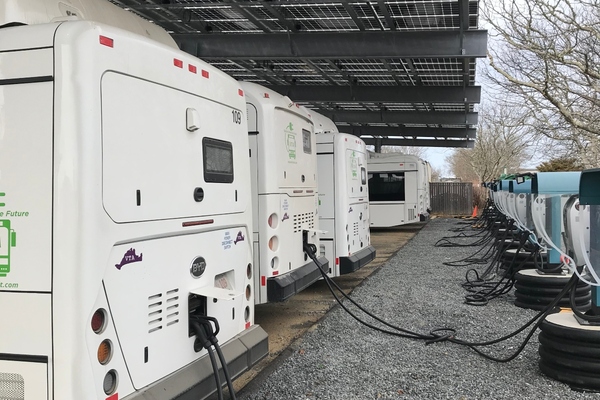
This system will allow the agency to reduce its demand on the grid during peak hours
“Our overriding priority is to provide a fleet that will serve the island for years to come with buses that are the most reliable, emission-free, fuel-saving vehicles available,” Angie Gompert, administrator at the VTA.
“In order to do this our infrastructure needs to support and reflect this commitment. A state-of-the-art transportation system is what our island community deserves and what the Martha’s Vineyard Transit Authority consistently strives to deliver.”
Induction charging stations
The network will also include induction charging stations that recharge the buses on route, allowing them to stay in service for their 200- to 300 miles-a-day circuit without detouring to recharge.
Planned for operation in the third quarter of 2021, the stations are wireless charging plates embedded in the ground at bus stops. The vehicles will drive over the charging stations as passengers board and exit the vehicle, enabling buses to be partially charged numerous times throughout the day at each stop.
“We applaud the VTA not only for [its] ambitious vision to electrify [its] transit system but also to take it one step further with a microgrid, which allows on-site energy generation and storage,” added Geoff Gunn, energy systems and zero emission vehicle lead at Arup.
“This trailblazing combination is what makes it truly sustainable and resilient as well as cost-effective.”
You might also like:
Why not try these links to see what our SmartCitiesWorld AI can tell you.
(Please note this is an experimental service)
How does the microgrid improve energy resilience during power outages?What role do induction charging stations play in bus fleet efficiency?How much carbon dioxide reduction is expected from the electric buses?In what ways does on-site solar power support the microgrid system?How does battery energy storage optimize overnight bus charging?air qualityArupBatteriesClimate change/Resilienceelectric buseselectric vehiclesEnergyFeaturedMartha's VineyardMicrogridRoadTransport
Latest City Profile
Latest Summit Speakers
(22-26 June)
SmartCitiesWorld Newsletters (Daily/Weekly)
You may also like these related articles...
BECOME A MEMBER
© 2026 SmartCitiesWorld
Smart Cities World Ltd, 37 Lombard Street, London, EC3V 9BQ