



















BUILD YOUR OWN
RESOURCE LIBRARY



Why the smart city’s missing layer is conversation
Dan Flores, head of tourism, Satisfi Labs, highlights how disconnected system layers means cities can miss out on the economic benefit of hosting major events.


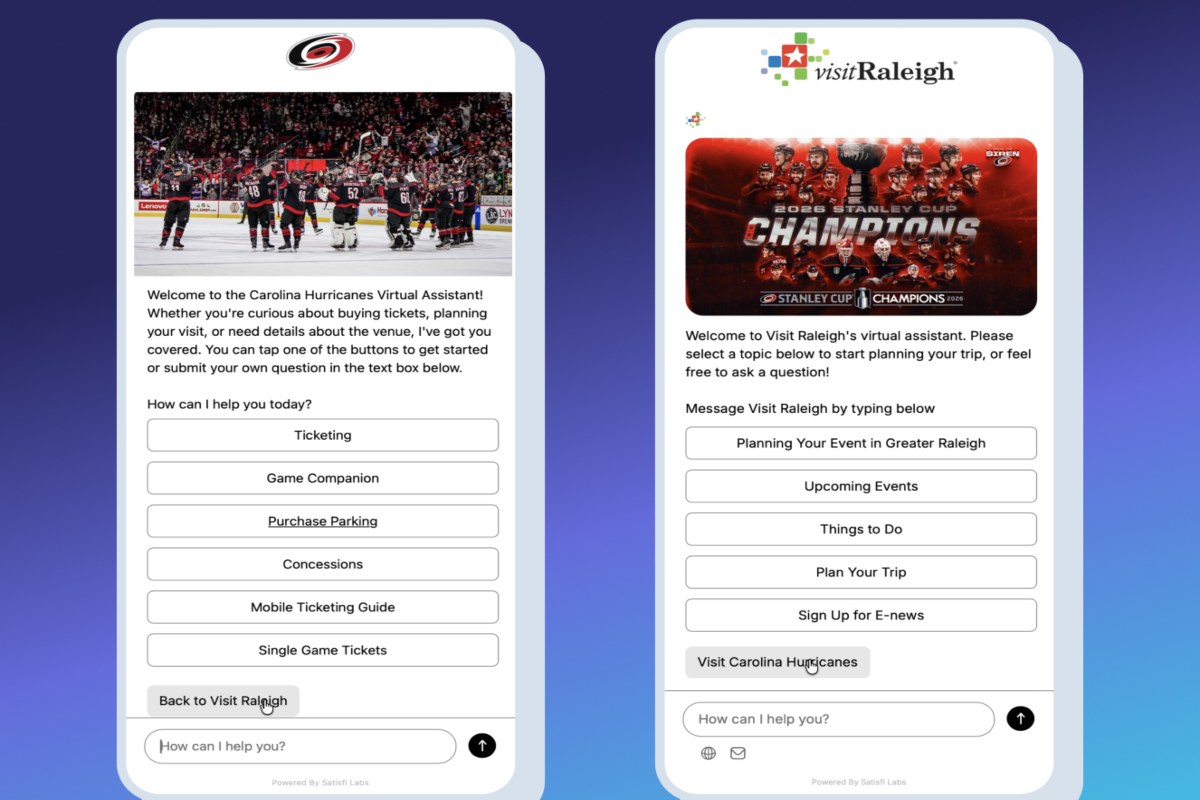
In the US city of Raleigh during the Stanley Cup, two AI agents handled nearly 4,000 conversations and saved 195 staff hours
Cities have spent a decade building smart infrastructure. Yet, cities working to become top tourism destinations need smart infrastructure that supports both residents and visitors. Sensors for traffic, dashboards for utilities, and apps for parking and permits are commonplace in most US cities.
What most have not built is a way for the systems that talk to residents and visitors to talk to each other, and that disconnect comes with a real economic cost.
Connecting layers and conversations
Visitors and residents increasingly get their answers from AI models like ChatGPT and Google’s AI-powered search, not from a municipality or destination marketing organisation’s own websites or app. Those models pull from whatever is publicly indexed, which often means outdated event listings, wrong parking rules, and generic answers with no connection to the agency actually responsible for the information.
A city’s transit authority, tourism board, and major attractions each maintain their own data, but no connected layer fills in the blanks for a visitor, leaving them confused instead of spending money at the destination.
Connecting those agents into a single conversational layer turns them into shared infrastructure that captures visitors wherever and whoever they are
Most city halls instinctively respond with a new app, bot, or portal. That approach just adds one more disconnected system. A more durable fix is to use the infrastructure cities already have in place by connecting the AI agents that public agencies, public organisations like tourism boards, and private venues such as stadiums and arenas already run.
Connecting those agents into a single conversational layer turns them into shared infrastructure that captures visitors wherever and whoever they are.
I’ve been working closely with cities, tourism boards, and attractions for decades, and here are three ways a connected agent layer functions as city infrastructure and drives local economies.
1. Always open for business. AI closes the after-hours service shortfall without new headcount, and without losing the spend that comes with it. A connected agent network answers a parking question at 11pm or a hotel question at 6am the same way it would during a staffed shift. In Raleigh, 43.5 per cent of visitor conversations during the Stanley Cup Final happened after hours, a volume of spending intent no city office was open to capture on its own.
2. No dead ends. It routes people to the right department automatically, keeping them in the conversation instead of losing them to a search. A question rarely stays inside one agency’s lane. A visitor asking about a game will also ask where to park, where to eat, and how road closures affect their route. When agencies operate on connected agents, a single conversation can move a visitor from a stadium authority to a tourism board to a restaurant recommendation without the visitor ever having to search a second website or place a call.
3. Cities own the answer. When cities control the AI, it keeps public information accurate at the source, instead of ceding both the answer and the economic upside to a general AI model. Public AI platforms have no mandate to get a city’s information right or to point visitors toward the destination’s own restaurants, hotels, and attractions. A connected municipal agent layer does.
Test case: Raleigh during the Stanley Cup Final
When the Carolina Hurricanes reached the 2026 Stanley Cup Final, Raleigh faced this problem at high volume. Both the team and Visit Raleigh, the city’s tourism organisation, were flooded with questions about parade routes, parking, road closures, and watch parties.
Rather than build something new, the two organisations connected the AI agents they already had. The two agents handled nearly 4,000 conversations and saved 195 staff hours, nearly five full work weeks that neither organisation had to staff for during the busiest season ever. With fans arriving from all 50 states and two countries, Wake County’s economic impact from the run reached $13.4m.
Test case: Miami hosting the World Cup
Miami faced the same challenge hosting the FIFA World Cup. The destination worked with the Miami Host Committee and tourism partners to collect and surface relevant programming, deals, and experiences across every digital channel.
The content was structured, regularly updated, and built to be readable by both visitors and AI search. The results showed that 50 per cent of all conversations occur outside business hours, while 15 per cent of questions were in Spanish, French, German, Italian, and Portuguese.
Infrastructure that has impact
The 2026 World Cup and the run-up to LA 2028 will put this to the test at a scale most cities have not planned for, and at a scale where uncaptured spending adds up fast. The cities that treat connected AI agents as infrastructure, the same way they treat roads, transit, and permitting systems, will handle that volume and capture the economic activity that comes with it.
Why not try these links to see what our SmartCitiesWorld AI can tell you.
(Please note this is an experimental service)
Why do disconnected city systems leave visitors with outdated answers?How did Raleigh connect its tourism and team AI agents?How many staff hours did Raleigh save during the Stanley Cup Final?What share of Miami’s visitor conversations happened outside business hours?Which visitor questions can a connected agent route between agencies?Latest City Profile
Latest Summit Speakers
(22-26 June)
SmartCitiesWorld Newsletters (Daily/Weekly)
You may also like these related articles...
BECOME A MEMBER
© 2026 SmartCitiesWorld
Smart Cities World Ltd, 37 Lombard Street, London, EC3V 9BQ