




























BUILD YOUR OWN
RESOURCE LIBRARY



OnDemand Trend Report Panel Discussion: Cognitive cities – building smarter, more responsive urban systems


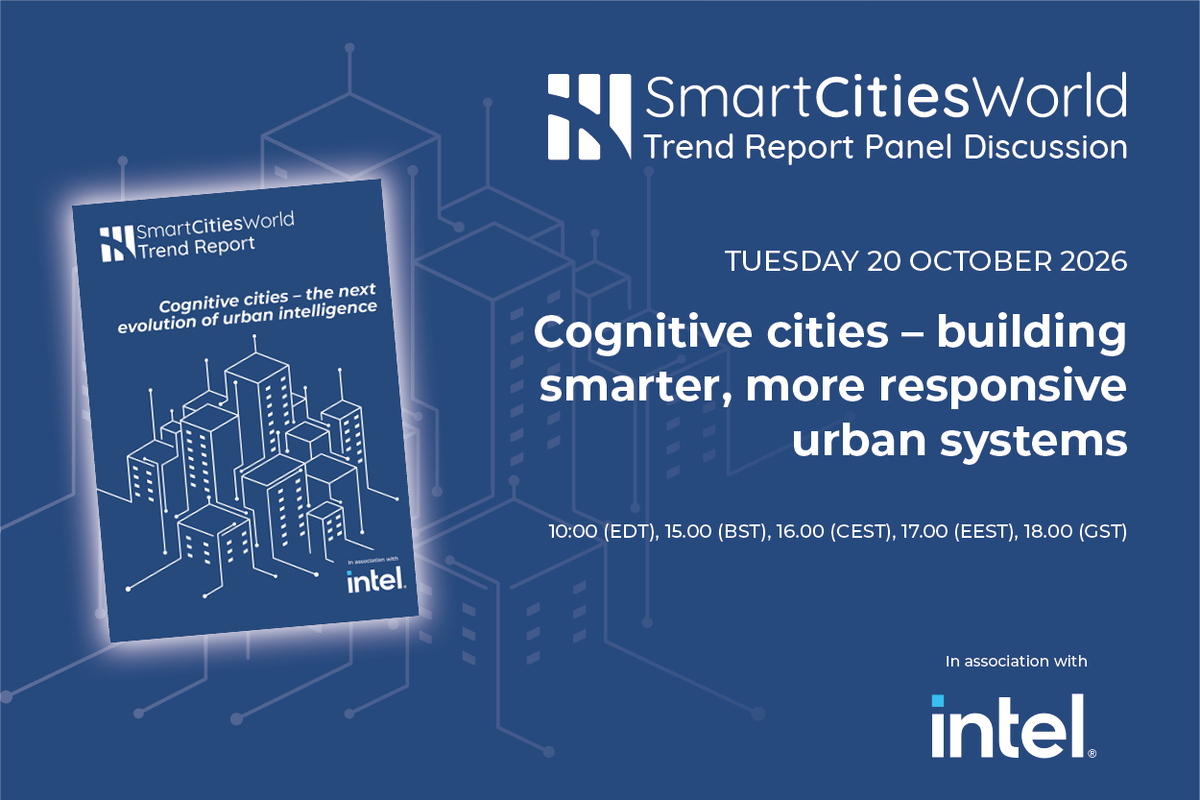
Date recorded: Tuesday 20 October 2026
Length: 60 minutes + Q&A
Cities have invested heavily in sensors, connectivity, cloud platforms and digital services, giving them access to more operational data than ever before. Yet many still face a fundamental challenge – turning that growing volume of information into timely, coordinated decisions that improve services and outcomes. As artificial intelligence becomes more capable and processing moves closer to where data is generated, the focus is shifting from simply monitoring the urban environment to understanding and responding to it.
Hosted in association with Intel, this webinar explores the emergence of the cognitive city – the next stage in the evolution of the smart city. It examines how computer vision, agentic AI, edge computing and physical AI can add intelligent capabilities to existing infrastructure, helping cities develop greater situational awareness, anticipate emerging issues and coordinate activity across departments and systems.
The discussion begins with computer vision, one of the most mature and accessible applications of urban AI, before considering how agentic AI can support workflows and how physical AI can translate digital insights into action across transport, utilities and the built environment. Throughout, the emphasis remains on augmenting human decision-making rather than replacing it, while addressing the governance, privacy and trust considerations that must underpin adoption.
Key discussion points include:
-
How cognitive cities build upon existing smart city investments
-
The evolution of computer vision from detection to real-time situational awareness
-
How agentic AI can coordinate workflows and operational responses
-
The role of edge AI in enabling faster, locally informed decisions
-
How physical AI connects digital intelligence with infrastructure and service
-
The importance of human oversight, explainability, privacy and data sovereignty
When you watch this, we may share your data with Intel in line with our Privacy Policy, and through carefully-evaluated legitimate interest.
Speakers
|
|
Raimundo Rodulfo CIO and Director of Innovation & Technology City of Coral Gables
Raimundo Rodulfo joined the City of Coral Gables in 2004 and currently serves as Director of Innovation and Technology and Chief Innovation Officer. He leads strategic planning, oversight and management of citywide IT operations, infrastructure and smart city initiatives. Under his leadership the city has received over 40 national and international awards and recognitions including first place nationwide in the Digital Cities 2018, first place nationwide in the Government Experience Award in 2023, first place in the U.S. Open Cities Index in 2019 and 2020, Smart Cities Connect Awards in Urban Infrastructure in 2020, 2023, 2024 and 2026, Smart Cities Council Innovation Excellence Award in 2022, IEEE Smart Cities Jury Award in 2022, Fully certified Intelligent Community in 2025, one of the "8 Smart Cities to Watch in 2020 by State Tech Magazine", one of the top 12 worldwide in the "Gartner Eye on Innovation Awards" in 2021, and one of the world’s "Top 7 Intelligent Communities of 2023 and 2024." |
|
|
|
Mike Lake CEO Leading Cities
As President and CEO of Leading Cities, Michael develops and establishes relationships with municipal governments, businesses and universities internationally, creating a global network of partner cities dedicated to implementing Smart City solutions that improve the quality of life in cities.
Leading Cities builds bridges between academia and action, between business and government, and between urban problems and solutions. Among its signature programs are AcceliCITY- among the largest, most prestigious smart and resilient city solutions focused competitions- and AcceliGOV—a competition of cities vying for globally sourced, expert-vetted, pre-paid pilot projects.
Michael’s career in public service spans from serving three United States Presidents as Special Assistant for White House Operations and Presidential Advance to serving the former Prime Minister of Ireland as a policy research analyst.
He is the only American nominated for the inaugural UK Smart Cities Awards 2017 in the category “Smart City Leader & Promoter and has been recognised globally as a pioneer in the space of Smart Cities for his leadership in networking cities across internationally. |
|
|
|
Renu Navale VP and General Manager, Health & Life Sciences and Cognitive Cities Intel
Throughout her career, Renu has thrived as a catalyst in big transformation. First, it was the network platform, followed by moving out to the edge. Now, she is focused on applying AI to power the digital infrastructure of healthcare – enabling real‑time, secure, and scalable innovation at the edge, as well as a city’s critical infrastructure to support people-driven initiatives for safety, sustainability, and communications, through open platforms and a global ecosystem.
For 25 years, she and her team have revolutionised edge computing and networking from strategy to execution, delivering over $1B in Fortune 100 annual revenue, consistently delivering results. |
|
 |
Luke Antoniou SmartCitiesWorld
Luke has been reporting on the implementation of smart technologies that benefit citizens and the public sector since 2017.
He has a particularly keen interest in smart and sustainable mobility and its role in influencing the decisions of urban planners, citizens and governments alike.
As rapid urbanisation continues, he keeps his finger on the pulse of the myriad urban challenges facing local and central governments, making new connections in the public and private sectors and finding new angles from which to cover the latest smart city developments around the world. |
In association with:

Why not try these links to see what our SmartCitiesWorld AI can tell you.
(Please note this is an experimental service)
How does a cognitive city build on existing smart-city investments?Why is computer vision central to the webinar’s discussion?How could agentic AI help cities coordinate operational responses?Why does edge AI matter for faster local decisions?What safeguards does the panel highlight for privacy and human oversight?Latest City Profile
Latest Summit Speakers
(22-26 June)
SmartCitiesWorld Newsletters (Daily/Weekly)
You may also like these related articles...
BECOME A MEMBER
© 2026 SmartCitiesWorld
Smart Cities World Ltd, 37 Lombard Street, London, EC3V 9BQ