




























BUILD YOUR OWN
RESOURCE LIBRARY



Opinions

Securing lighting: protecting the backbone of connected cities Sponsored by Paradox Engineering

AI’s next stop: transforming urban transportation responsiblySponsored by Microsoft
Intelligent data centre networking for a smarter future
Opinions30 Jul 2025
Sponsored by HuaweiDiscover how Huawei is pushing the boundaries of innovation in data centre switching, and earning worldwide recognition for its work across software and hardware.



As enterprises and public organisations move deeper into an era defined by AI computing, automation, and cloud-native architectures, data centres must rapidly evolve
As the foundation of the digital economy, data centre networks are under unprecedented pressure to deliver faster, smarter, and more resilient performance. With the rise of AI, cloud-native services, edge computing, and increasingly complex enterprise workloads, traditional network architectures are no longer sufficient.
Businesses and public sector organisations alike require data centres that can adapt in real time, scale seamlessly, and maintain security and uptime in increasingly dynamic environments. In this context, continuous innovation in data centre networking is essential – not only to ensure operational efficiency, but also to unlock the full potential of emerging technologies that are reshaping industries and cities worldwide.
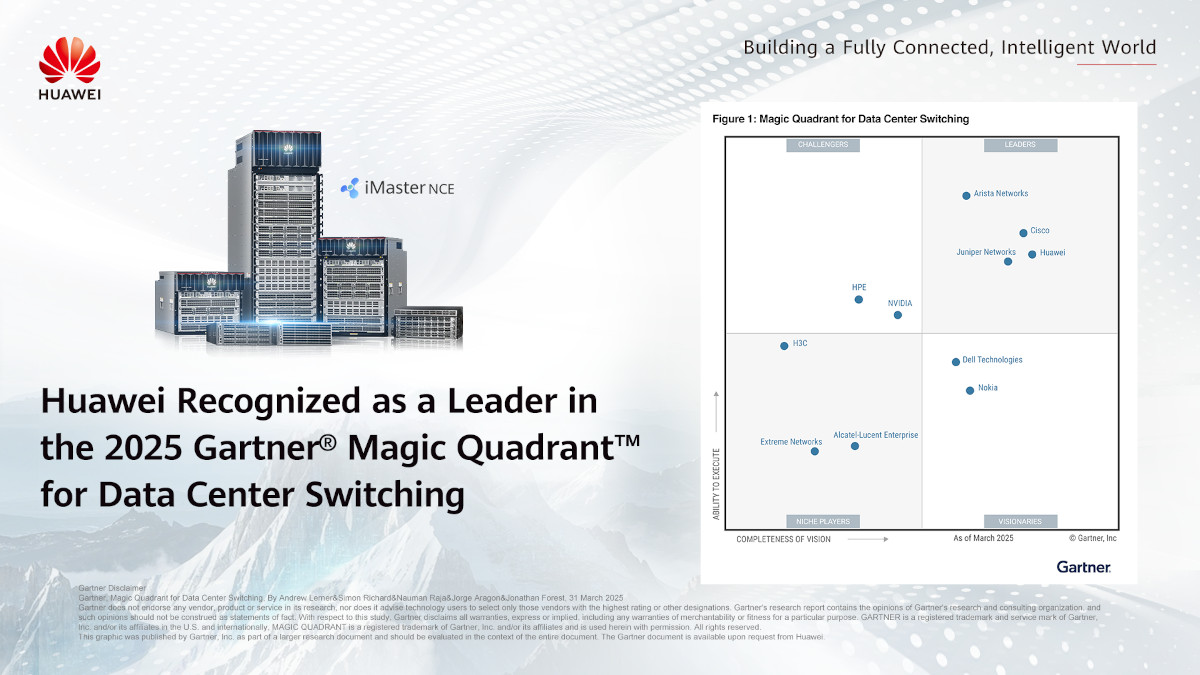
At the forefront of this transformation is Huawei, which has been recognised as a Leader in the 2025 Gartner Magic Quadrant for Data Centre Switching – a testament to its sustained investment in intelligent networking and its ability to anticipate and shape the future of data centre infrastructure. Huawei placed furthest on the “Completeness of Vision” axis – affirming the company’s strategic foresight and sustained innovation in a domain fundamental to digital transformation.
Businesses and public sector organisations alike require data centres that can adapt in real time, scale seamlessly, and maintain security and uptime in increasingly dynamic environments
This recognition by Gartner reinforces Huawei’s position at the forefront of data centre networking. As enterprises and public organisations move deeper into an era defined by AI computing, automation, and cloud-native architectures, data centres must rapidly evolve to deliver on the demands of performance, flexibility, and resilience. Huawei’s leadership reflects its ability to anticipate this evolution and engineer end-to-end solutions that meet – and often redefine – global benchmarks for intelligent networking.
Innovation in data centre networking software
The data centre switch market is both foundational and fast-moving. Network demands are growing exponentially, driven by AI training workloads, hybrid cloud architectures, and latency-sensitive applications. Huawei has responded with a decade of innovation and investment, now culminating in a next-generation portfolio of switches, optical modules, and software platforms designed for the data-intensive world of tomorrow.
Central to this advancement is Huawei’s Xinghe Intelligent Fabric Solution, which reimagines the data centre network as an integrated, intelligent architecture capable of autonomous optimisation, deep visibility, and zero-loss connectivity.
Xinghe Intelligent Fabric: a three-layered approach
Huawei’s Xinghe Intelligent Fabric consists of three core layers: AI Brain, AI Connection, and AI Network Elements (NEs). Together, these layers form an intelligent, self-regulating, and high-performance digital backbone built for next-generation enterprise demands.
At the heart of the system is Huawei’s AI Brain – a combination of the NetMaster large network model and the network digital map. These tools enable intelligent orchestration of processes across the data centre, allowing for automated deployment, fault simulation, and proactive issue resolution. Notably, this architecture automates rectification of 80 per cent of faults, significantly boosting operational efficiency and reducing downtime.
With the growing intensity of AI workloads and the increasing complexity of distributed applications, physical infrastructure must now deliver on performance, reliability, and energy efficiency at scale
The AI Connection relies on Huawei’s proprietary network-scale load balancing (NSLB) algorithm, which supports intelligent path planning to remove bottlenecks and boost AI training efficiency by over 10 per cent. This is complemented by Huawei’s iReliable three-level reliability technology, which uses advanced optical diagnostics – including resistance to channel loss – to maintain zero service interruptions.
Huawei’s CloudEngine series switches and StarryLink optical modules form the AI Network Elements of this architecture. These provide real-time traffic awareness, high-precision performance monitoring, and robust security through group-based isolation and physical encryption at the port level. This results in enhanced visibility into packet loss and latency, crucial for AI and high-frequency applications.
Pushing the boundaries of hardware scale and efficiency
Huawei’s continued leadership in data centre networking is underpinned by its sustained focus on hardware innovation – not only in switching capacity but also in transmission, heat management, and physical-layer security. With the growing intensity of AI workloads and the increasing complexity of distributed applications, physical infrastructure must now deliver on performance, reliability, and energy efficiency at scale.
At the centre of this effort is Huawei’s latest CloudEngine XH series, which includes two groundbreaking additions:
- The CloudEngine XH9330 – the industry’s highest-density 128 × 800GE fixed Ethernet switch – sets a new standard for AI cluster scalability
- The CloudEngine XH9230 – the world’s first 128 × 400GE liquid-cooled fixed switch – delivers industry-leading thermal efficiency and supports high-performance operations in dense environments.
Both switches are engineered to accommodate Huawei’s proprietary iFlashboot technology, which ensures continuous training and uninterrupted data flow even during abnormal restarts or software upgrades. This is critical for organisations operating large-scale AI, analytics, or cloud-native environments where even brief interruptions can lead to service degradation or data loss.
Complementing these advances in switching architecture are Huawei’s StarryLink optical modules, which represent a significant leap forward in transmission performance, network stability, and physical-layer security. Announced at MWC 2025, these modules were developed specifically to meet the evolving demands of next-generation data centre networks.
These modules are built on Huawei’s “3S” foundation – spanning, stable, and secure. StarryLink modules deliver:
- Ultra-long-distance transmission (spanning): thanks to a unique optical path coupling algorithm and advanced design optimisation, StarryLink modules support transmission distances up to twice the industry average
- Rapid diagnostics and high stability (stable): proprietary short-distance optical return loss positioning technology enables administrators to locate dirty or loose links within minutes – exceeding the industry norm of hours. Additionally, exclusive channel loss resistance allows AI tasks to continue uninterrupted even during temporary disconnections.
- Intrinsic encryption at the physical layer (secure): Huawei’s integration of PHYSEC encryption directly into the module’s optical Digital Signal Processor (oDSP) ensures that all packets are encrypted end-to-end, eliminating the risk of data leakage via physical links.
Together, the CloudEngine switches and StarryLink optical modules represent a new benchmark in data centre infrastructure. They are purpose-built to handle the data volumes, thermal requirements, and security risks associated with modern AI, multi-cloud, and real-time applications – all while enabling more compact, energy-efficient, and future-proof deployments.
These hardware innovations make Huawei’s portfolio not only technologically advanced but also strategically aligned with the evolving priorities of global enterprises – from cost efficiency and performance to long-term resilience and security.
Ongoing innovation and enterprise support
Huawei’s recognition by Gartner builds on its growing influence across the global data centre market. With a customer base spanning 100+ countries and more than 21,000 enterprise clients, Huawei supports data centre deployment across industries including finance, transportation, energy, healthcare, and government.
The company operates 14 global R&D centres and employs over 3,000 R&D specialists in its Data Communication Product Line alone. This sustained commitment to innovation is evident in Huawei’s roadmap, which continues to prioritise:
- High-performance switching architectures for AI workloads
- Seamless integration of network and security management
- Industry-first reliability and automation capabilities
- Expanding the CloudEngine and StarryLink portfolio.
As enterprise transformation deepens and digital infrastructure becomes a strategic asset, Huawei is well positioned to support clients through the transition – not just with best-in-class technology, but also with a vision aligned to the needs of future-ready businesses.
Building the foundation for future cities
Huawei’s leadership in data centre switching has delivered measurable benefits in the public sector. In one recent government deployment, a provincial authority facing rising digital service demands and outdated network infrastructure turned to Huawei to modernise its operations.
Using Huawei solutions and platforms, the authority implemented an SDN-based architecture with drag-and-drop deployment, automated configuration, and real-time fault detection.
The result was a 50 per cent increase in deployment efficiency, 90 per cent improvement in O&M responsiveness, and a network ready to support digital citizen services and cross-department collaboration.
Huawei’s intelligent data centre solutions continue to provide the digital backbone for modern e-government strategies – enhancing public service delivery while reducing complexity and operational cost.
Huawei’s position as a Leader in Gartner’s 2025 Magic Quadrant for Data Centre Switching is both a recognition of past achievement and a validation of its future-facing strategy. Through the combination of high-performance hardware, AI-augmented software, and secure optical connectivity, Huawei is enabling enterprises and governments to confidently move into a digitally intelligent era.
By redefining what’s possible in data centre networking – and delivering innovations that drive real-world performance and reliability – Huawei is not just keeping pace with digital transformation but helping to lead it.
To find out more about Huawei’s innovative data centre work, click here.
Why not try these links to see what our SmartCitiesWorld AI can tell you.
(Please note this is an experimental service)
How does Huawei’s Xinghe Intelligent Fabric improve data centre fault management?What benefits do CloudEngine XH series switches offer for AI cluster scalability?How do StarryLink optical modules enhance data transmission security and stability?In what ways does AI Brain automate network orchestration and fault resolution?How does Huawei’s network-scale load balancing boost AI training efficiency?Latest City Profile
Latest Summit Speakers
(22-26 June)
SmartCitiesWorld Newsletters (Daily/Weekly)
You may also like these related articles...
BECOME A MEMBER
© 2026 SmartCitiesWorld
Smart Cities World Ltd, 37 Lombard Street, London, EC3V 9BQ