















BUILD YOUR OWN
RESOURCE LIBRARY



Podcasts
Cities Thriving on Lighting, Episode 2 – Simplicity by design in smart lightingSponsored by Paradox Engineering
Cities Thriving on Lighting, Episode 1 – Lighting as the backbone of the smart citySponsored by Paradox Engineering
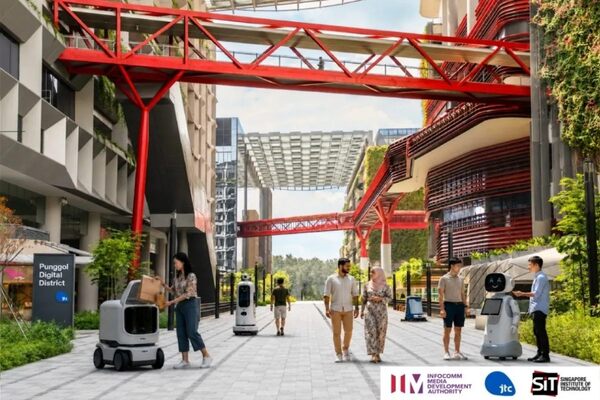
Singapore to test physical AI in Punggol Digital District
Multi-operator robots will be deloyed in a mixed-use public area, providing a real-world environment where robots and AI systems are tested and refined.


 At a glance
Who: Singapore IMDA; Punggol Digital District; JTC; Singapore Institute of Technology (SIT).
What: Singapore is to establish a living testbed and innovation launch pad for physical AI at Punggol Digital District. It has also unveiled new global AI partnerships and initiatives as well as strengthened its AI governance.
Why: To advance robotics capabilities and infrastructure into urban spaces and strengthen Singapore’s position as a leading AI hub.
Where: The robots and smart infrastructure will be deployed at Punggol Digital District later this year.
Singapore is to establish a living testbed and innovation launch pad for physical artificial intelligence (AI), such as robotics and smart digital infrastructure, at Punggol Digital District (PDD) later this year.
It was one of a number of announcements made at ATxSummit 2026, the flagship event of Asia Tech x Singapore (ATxSG), which also included the unveiling of new global partnerships and initiatives to strengthen Singapore’s position as a leading AI hub.
Advancing physical AI into urban spaces
The aim is to advance robotics capabilities and infrastructure into urban spaces. Singapore Infocomm Media Development Authority (IMDA), JTC, the statutory board under the Ministry of Trade and Industry that champions sustainable industrial infrastructure, and the Singapore Institute of Technology (SIT) will be setting up the living testbed jointly with other government agencies and industry partners.
Robotics and embodied AI (EAI) mark a major shift in AI development moving beyond screen-based tools to physical systems that can perceive, reason, and act in the real world. This will be Singapore’s first testbed to deploy multi-operator robots in a mixed-use public area at PDD, providing a real-world environment where robots and AI systems are continuously tested and refined. It aims to:
- Streamline regulation and integrate physical-digital infrastructure seamlessly
- Ensure robot services deployed by businesses in public spaces are complementary and commercially viable.
Robots deployed in the testbed will also be required to meet safety standards and defined operational parameters, for safer human-robot co-existence in communities
In the initial phase, Certis, DHL, Grab and QuikBot will co-design testbed conditions, together with IMDA, JTC and SIT, within PDD that can enable sustainable, commercially viable robotics services in public spaces.
These services will include food and parcel delivery, working alongside delivery partners to improve first- and last-mile efficiency, as well as security patrolling and cleaning. They will complement existing human operations by extending services beyond office hours, patrolling hard-to-reach spaces, and conducting cleaning more frequently. In turn, this will allow workers to take on higher-value roles such as supervision, operations management, and service delivery.
Read More
Robots deployed in the testbed will also be required to meet safety standards and defined operational parameters, for safer human-robot co-existence in communities.
The PDD testbed is facilitated in collaboration with the Land Transport Authority (LTA), through a precinct-level exemption framework under the Active Mobility Act. This gives Autonomous Mobile Robot (AMR) operators greater flexibility to trial different use cases on public paths within PDD, without having to apply separately to LTA for individual exemption orders, subject to safeguards and conditions to ensure public path safety.
Together with the National Robotics Programme (NRP), IMDA will also collaborate on EAI use cases with:
- Knowledge partners: FieldAI and Thoughtworks, who bring deep expertise in digital workflows, data platforms, and AI systems
- Robotics companies: Slamtec, Unitree, and QuikBot, who specialise in automation, AI, and mobility, developing and trialling EAI use cases through SIT’s new Centre for Intelligent Robotics at PDD.
IMDA will trial next-generation infrastructure that pushes the boundaries of how robotic systems communicate, coordinate, and scale safely to lay the groundwork for a truly physical AI future.
These collaborations will help test, refine, and scale Singapore’s robotics capabilities. As AI robotic systems begin to interact directly with people, infrastructure, and everyday city environments, they will collect sensor-rich data, learn from their surroundings, and adapt to changing conditions, becoming more responsive and useful over time.
More details on the trials and use cases in the PDD testbed will be shared when it is launched later this year.
AI research lab
Meanwhile, frontier AI research is key to sustaining Singapore’s competitive edge. To sharpen Singapore’s manufacturing advantage, NVIDIA is launching an AI research lab focused on advancing embodied and efficient AI in collaboration with university researchers, industry partners, and government agencies. The lab is NVIDIA’s Singapore hub and second research presence in Asia Pacific.
The Ministry of Digital Development and Information (MDDI) and Google announced an expansion of Google’s collaboration with the Singapore Government through a new National AI Partnership. This partnership aims to harness frontier AI as a force for good – including deploying AI to solve society’s challenges, fostering an AI-ready workforce in Singapore, and creating a secure and trusted ecosystem.
Singapore is advancing ecosystem-wide initiatives to support AI adoption, particularly in high-trust sectors like finance and the public sector, where reliability, governance and safety are critical for real-world deployment
MDDI and OpenAI signed a memorandum of understanding (MoU) to collaborate on the new OpenAI for Singapore initiative to strengthen Singapore’s position as a leading hub for applied AI innovation. The MoU comprises three pillars of collaboration: advancing applied AI innovation, building AI talent, and making AI accessible to citizens, enterprises and the public sector. The partnership represents a commitment of more than S$300m by OpenAI to strengthen Singapore’s AI ecosystem.
Beyond sector-specific deployments, Singapore is advancing ecosystem-wide initiatives to support AI adoption, particularly in high-trust sectors like finance and the public sector, where reliability, governance and safety are critical for real-world deployment.
Temus, a Temasek-established AI and digital transformation firm, will launch an AI Foundry to help enterprises deploy AI solutions at scale and develop talent pipelines. Supported by Digital Industry Singapore (DISG), the Foundry will hire 50 professionals across roles such as AI architects, data scientists, AI/ML engineers, product owners, and full-stack, DevOps and UX engineers, who will be deployed on live enterprise projects in high-value sectors such as financial services and precision health.
Separately, Temus will sign a MoU with AI Singapore (AISG) to explore joint prototypes, reusable delivery frameworks and enterprise deployments that bring nationally developed AI capabilities into real-world operating environments.
To ensure governance keeps pace with AI, Singapore has updated its Model AI Governance Framework for Agentic AI (MGF), launched at the World Economic Forum in January 2026. It now includes real-world case studies and new best practices. The update drew on feedback and contributions from over 50 organisations – including AWS, DBS, Google, and Salesforce, reflecting broad industry input into the framework’s development. It also features over 10 new case studies, including from GovTech Singapore.
AI and Machine LearningAI CityXchange - AI FoundationsAnalyticsConnectivity & DataGovernance and CitizenPeople and SkillsPublic-private partnershipsSensorsSingaporeurban space
Latest City Profile
SmartCitiesWorld Newsletters (Daily/Weekly)
You may also like these related articles...
BECOME A MEMBER
© 2026 SmartCitiesWorld
Smart Cities World Ltd, 37 Lombard Street, London, EC3V 9BQ