






























BUILD YOUR OWN
RESOURCE LIBRARY



Vianova launches mobility intelligence platform
Co-built with cities, Vianova Intelligence converts data into street-level actionable intelligence to help cities make better decisions about shared mobility.


 At a glance
Who: Vianova; Berlin BVG.
What: Vianova is launching its Intelligence Platform, co-built with cities, that converts data into street-level actionable intelligence.
Why: To help cities make better decisions about safety, infrastructure, and shared mobility policy.
Where: The platform’s development is based on Vianova’s work with cities around the world.
Mobility data analytics company Vianova is launching a new platform that converts data into street-level actionable intelligence that helps cities make better decisions about safety, infrastructure, and shared mobility policy.
The Vianova Intelligence Platform is built on the company’s partnerships with cities, transport authorities and operators across 17 countries.
AI agents and anomaly detection
The platform incorporates natural language querying, artificial intelligence (AI) agents with deep context in shared mobility and traffic operations, and AI-based anomaly detection, so non-technical users can get to answers without needing a GIS or data science background.
The vision is to integrate AI because it can meaningfully help non-data teams interact with complex mobility and geospatial data, make sense of it, and reach better insights that drive operations and strategy.
By combining shared mobility data with public transport and other open standards, the platform gives cities a clear picture of how shared mobility supports public transport
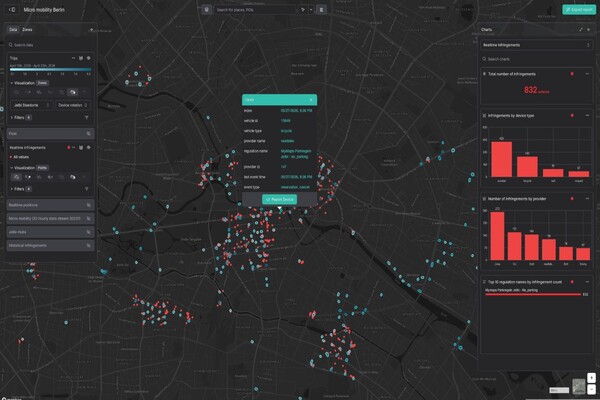
Its cities’ partnership collaborations includes its work with Berlin’s BVG to scale up its number of mobility hubs. BVG runs Jelbi, a programme that integrates shared bikes, e-scooters, e-mopeds, and car-sharing with Berlin’s transit network. Since becoming an active Vianova user in 2023, BVG manages over 50,000 vehicles from eight operators through a single platform, with analytics covering trip volumes, parking behaviour, vehicle turnover, and mode distribution across the network.
When Berlin mandated the 2,300-hub expansion in December 2025, Vianova gave BVG the analytical foundation to act at scale, turning a policy mandate into an executable infrastructure plan.
Read More
This kind of city-scale intelligence is now the foundation of Vianova’s next chapter with the platform built to bring that same capability to every city.
Vianova said the platformʼs flexibility means that public authorities and the operators that serve them can use the tooling to support many different use cases for integrating shared bikes, shared scooters, and even shared cars into the sustainable transport system.
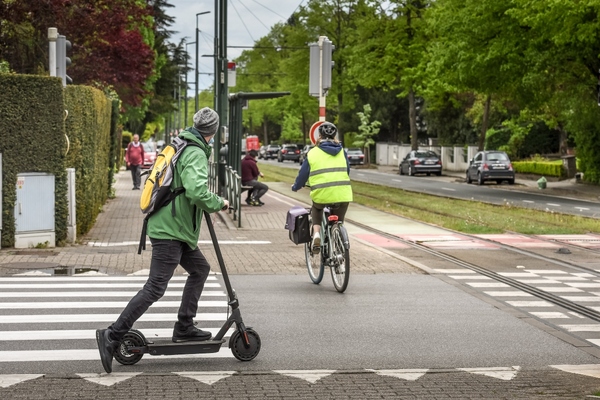
For example, it blends city crash data with operator-level trip information to surface the specific junctions, corridors, and bike lanes where risk to micromobility travellers is highest. Cities can identify the most dangerous routes, take targeted action, and evaluate the impact in weeks, not years.
By integrating data from IoT devices and scooter cameras, cities can understand where user behaviour departs from expectations, including advanced parking analytics and compliance metrics on where and when riders are sidewalk riding.
The platform also identifies the gap between the existing active transport network and current riding behaviour, helping cities prioritise limited budgets to make cycling and scooting safer and more pleasant.
By combining shared mobility data with public transport and other open standards, the platform gives cities a clear picture of how shared mobility supports public transport, from scooter trips ending near bus stops to the relationship between shared mobility growth and transit ridership.
Vianova works with more than 150 cities, transport authorities, and fleet operators across 17 countries in Europe, North America, the Middle East, and Asia-Pacific. It is based in Paris and its platform is GDPR-compliant by design.
AI and Machine LearningAI CityXchange - Scaling AIAnalyticscongestionConnectivity & DataDataMicromobilitymobilityRoad
Latest City Profile
Latest Summit Speakers
(22-26 June)
SmartCitiesWorld Newsletters (Daily/Weekly)
You may also like these related articles...
BECOME A MEMBER
© 2026 SmartCitiesWorld
Smart Cities World Ltd, 37 Lombard Street, London, EC3V 9BQ