










 22 - 26 June 2026: Find out more








BUILD YOUR OWN
RESOURCE LIBRARY



Bikeway with public art links two sides of Salt Lake City
The 400 South Viaduct Trail is one of only two routes where residents can cross the city on foot or bike without the possibility of waiting for a train to pass.


 At a glance
Who: Salt Lake City; Laura Haddad and Tom Drugan; Salt Lake City Arts Council.
What: Salt Lake City officials have opened the 400 South Viaduct Trail bridge, marking the completion of a new protected bike route that also features Strut, a public artwork composed of artist-designed fence and concrete barrier elements.
Why: To link downtown and the Granary District to the extended 300 West path and provide one of only two routes where residents can cross the city on foot or by bike without the possibility of waiting for a train to pass.
When: The 400 South Viaduct Trail ribbon-cutting took place at the end of May.
Salt Lake City officials have cut the ribbon on the 400 South Viaduct Trail bridge, marking the completion of a new protected bike route that links downtown and the Granary District to the extended 300 West path.
The 400 South Viaduct Trail is one of only two routes where residents can cross the city on foot or by bike without the possibility of waiting for a train to pass.
Artist-designed fence and concrete barrier
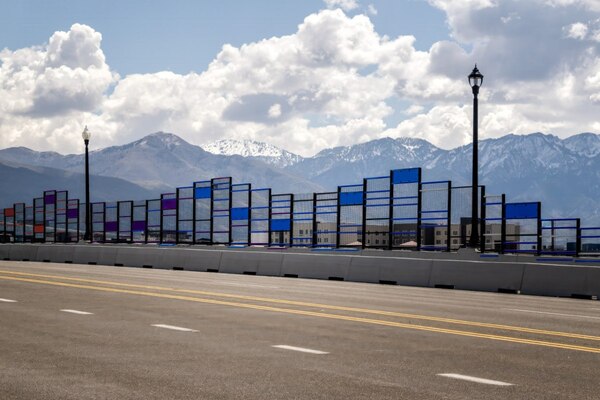
The trail also features Strut, a public artwork composed of artist-designed fence and concrete barrier elements inspired by the colours of the surrounding landscape and neighbourhood.
It was created by the Seattle-based artist team of Laura Haddad and Tom Drugan and, extending nearly 2,000 feet along the corridor, it makes it the longest continuous public artwork in Utah to date.
“The 400 South viaduct used to be an unsafe and unwelcoming place to walk or bike. Now, with a protected trail, concrete barrier, and public art, it’s a real connection between neighbourhoods”
“For westside residents, this trail means a safer, more direct way to reach downtown, school, work, parks, and more without needing a car,” said mayor Erin Mendenhall.
“The 400 South viaduct used to be an unsafe and unwelcoming place to walk or bike. Now, with a protected trail, concrete barrier, and public art, it’s a real connection between neighbourhoods.”
Read More
The bikeways and Strut reflect shared goals among the City and its partners: streets that connect people no matter how they choose to travel and art that builds on neighbourhood pride.
“Art can transform how people experience infrastructure,” said Tammy Hunsaker, director of the Department of Community and Neighbourhoods. “It can create moments of wonder, belonging, and civic pride in the places we move through every day.”
Salt Lake City Arts Council said that the City envisioned this project as an example of how infrastructure can also create civic identity and a stronger sense of place. It added that one of the central ideas behind Strut is the concept of “stitching the two sides of the viaduct together through art, design, and infrastructure”.
Haddad and Drugan were embedded into the project’s design process as part of the larger infrastructure team. In a press statement the Arts Council said: “Rather than functioning as an artwork added onto a project, Strut demonstrates how public art can be fully integrated into public infrastructure itself.
“Art can transform how people experience infrastructure. It can create moments of wonder, belonging, and civic pride in the places we move through every day”
“This project demonstrates what is possible when artists, engineers, fabricators, planners, transportation professionals, and community members collaborate from the very beginning of a project to reimagine a shared public space.”
Community engagement also played a major role in shaping the artwork throughout the design process. Haddad and Drugan spent significant time listening to West Side residents to ensure the final design reflected the voices, experiences, and energy of the community.
“The Salt Lake City Arts Council is proud to support projects like Strut that elevate everyday infrastructure into something memorable, welcoming, and uniquely Salt Lake City,” said the Arts Council in its statement.
The City hosted a celebration bike ride marking the completion of two new bikeways and a public art installation.
Why not try these links to see what our SmartCitiesWorld AI can tell you.
(Please note this is an experimental service)
How does the viaduct trail improve pedestrian and cyclist safety metrics?What measurable impacts has Strut had on neighbourhood sense of place?How were West Side residents engaged in the artwork's design process?How can protected bikeways increase micromobility usage for commuting?What design features enabled Strut's integration into infrastructure planning?
Latest City Profile
Latest Summit Speakers
(22-26 June)
Latest Urban Exchange Podcast
Latest Special Report
SmartCitiesWorld Newsletters (Daily/Weekly)
You may also like these related articles...
BECOME A MEMBER
© 2026 SmartCitiesWorld
Smart Cities World Ltd, 37 Lombard Street, London, EC3V 9BQ