















 22 - 26 June 2026: Find out more















BUILD YOUR OWN
RESOURCE LIBRARY



Navigation app goes live in Singapore library
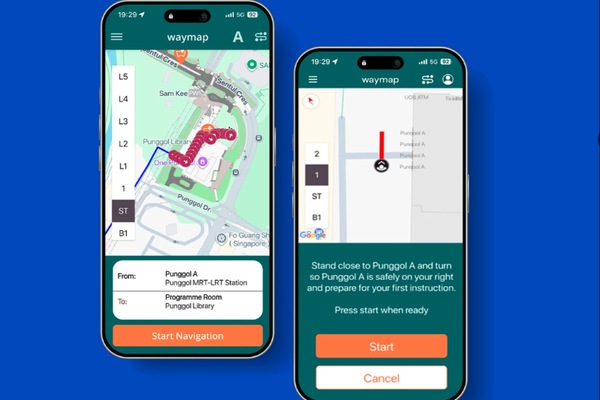
Waymap provides accessible step-by-step instructions via audio and on-screen and works using motion sensors, AI-powered algorithms as well as digital maps.


 At a glance
Who: Singapore’s National Library Board (NLB); Punggol Regional Library; Waymap.
What: NLB’s Punggol Regional Library has gone live with Waymap, the personal navigation app that works indoors, outdoors and underground.
Why: To provide accessible step-by-step instructions via audio and on-screen.
When: The app has gone live.
Singapore’s National Library Board (NLB) has gone live with Waymap, the personal navigation app that works indoors, outdoors and underground to make spaces more accessible.
Waymap is available for library-goers to use at Punggol Regional Library, in the northeast of Singapore Island, which is the largest library in Singapore and the newest of the NLB’s four key regional libraries.
Inclusivity and accessibility
Standing five storeys tall, Punggol Regional Library opened in 2023 and has a strong focus on accessibility, with accessible collections, features such as calm pods, and also assistive technology devices, such as keyboards with large print keys. It has an entire floor devoted to technology with facilities for 3D printing, robotics and digital cutting that can be used by NLB members.
The go-live is the latest step in Waymap’s Singapore roll-out, which has already seen the app become available at Sam Kee Light Rail Transit station and Punggol Mass Rapid Transport station, both of which are within a short walk of Punggol library.
“Libraries are a new and exciting use case for Waymap. They are a classic example of an indoor public space that the Waymap app can make much more accessible for users and staff”
Waymap is also up and running at Tampines Bus Interchange and Tampines Mass Rapid Transit station, in the east of the island.
The app provides accessible step-by-step instructions via audio and on-screen. It works using the motion sensors in a phone, AI-powered algorithms and digital maps, and doesn’t need any external equipment. It adapts to the individual user and claims to get better with every use.
Read More
“Libraries are a new and exciting use case for Waymap,” said Celso Zuccollo, Waymap’s CEO. “They are a classic example of an indoor public space that the Waymap app can make much more accessible for users and staff.”
“The well-known personal navigation apps don’t tend to work indoors, but Waymap does. It means Waymap users can get step-by-step instructions, from, say, the platform of one the nearby stations to specific points inside the library, such as the Storyteller Cove, Story Pods, Café or Family Zone. We’re looking forward to more go-lives in Singapore this year, with further exciting venues in the pipeline.”
“Finding your way to and within Punggol Library just got easier,” said a spokesperson for Singapore’s National Library Board, “We’re excited to launch our trial wayfinding service on Waymap – a free audio-based navigation app that helps you navigate within the library, and from Punggol MRT/LRT and Sam Kee LRT stations right to our library doors.”
In early 2025 Waymap went live across the whole of Washington DC’s public transportation system, including 98 rail stations, 325 bus routes and 11,000 bus stations. In the summer of 2025 Waymap went live at Lord’s Cricket Ground in London, before going live on bus routes in stations in Austin, Texas later in the year. In February Waymap went live at the Royal Hospital for Children and Young People in Edinburgh, and is launching further exciting public venues in 2026.
Why not try these links to see what our SmartCitiesWorld AI can tell you.
(Please note this is an experimental service)
How does Waymap use phone motion sensors and AI for indoor positioning?How does Waymap improve accessibility for visually impaired library users?How is Waymap integrated with nearby MRT/LRT and bus station maps?What data governance measures ensure user privacy and security in Waymap?How can Waymap scale to cover entire cities and multiple public venues?AI and Machine LearningAI CityXchange - Scaling AIConnectivity & DataGovernance and CitizeninclusivitySingapore
Latest Summit Speakers
(22-26 June)
Latest City Profile
SmartCitiesWorld Newsletters (Daily/Weekly)
You may also like these related articles...
BECOME A MEMBER
© 2026 SmartCitiesWorld
Smart Cities World Ltd, 37 Lombard Street, London, EC3V 9BQ