




















BUILD YOUR OWN
RESOURCE LIBRARY



Podcasts

Cities Thriving on Lighting, Episode 2 – Simplicity by design in smart lightingSponsored by Paradox Engineering
Cities Thriving on Lighting, Episode 1 – Lighting as the backbone of the smart citySponsored by Paradox Engineering
How shared transport can reduce UK emissions
A study carried out by CoMoUK reveals the extent to which the use of shared transport schemes in England and Wales could lead to a reduction in emissions.


Millions of daily commutes by car owners in England and Wales could be done by shared transport instead, leading to a huge reduction in emissions, new research has found.
The study, carried out by Collaborative Mobility UK (CoMoUK), the UK’s national charity for shared transport, reveals that if people who currently travel short distances to work by car used shared e-bikes or e-scooters instead, one million tonnes of greenhouse gas emissions could be saved every year.
This is around one per cent of the emissions caused by domestic UK travel, illustrating how shared transport could make a significant contribution to the drive for net zero.
Shared transport programmes
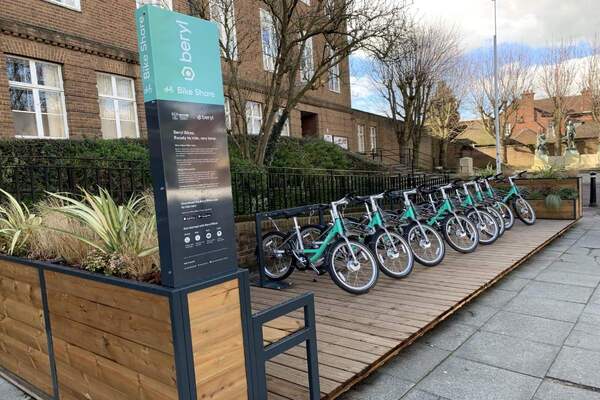
Shared transport in the study includes schemes such as car clubs, bike and e-bike sharing, public e-scooter hire and informal ride-sharing or carpooling.
The research, funded by the Foundation for Integrated Transport, also found that if car clubs reach their full potential, around 1.6 million fewer cars would be on the roads, freeing up almost 20 square kilometres of road space.
“As this new research illustrates, there is enormous and unrealised potential for this innovative sector to take more cars off our roads, cut traffic congestion further, improve our air quality and help us reach net zero”
To estimate the potential of shared transport, CoMoUK used data from the 2021 census in England and Wales and combined it with information from existing users. The charity was able to identify how many people and households share the key characteristics of shared transport users, and therefore how many more could potentially use shared transport in the future under ideal conditions, and if provision was continuously expanded over the next decade and beyond.
The resulting research found that up to 7.2 million households in England and Wales, or 29 per cent of the total, could feasibly use car clubs. If they did so, this would cut the number of car kilometres driven each year by 1.8 billion, as well as leading to 1.6 million fewer cars being on the roads.
Read More
The reduction in total vehicle numbers would free up 18.3 square kilometres of space, or around 1,700 football pitches.
The research also found that 7.4 million short commutes in urban areas that are currently made by car could feasibly be made by shared e-bikes or e-scooters instead. If this change took place, around one million tonnes of greenhouse gas emissions could be saved each year, equivalent to one per cent of the emissions currently resulting from domestic UK travel.
The report also made seven recommendations for action to maximise the potential of shared transport. These call for governments, councils, the private and third sector to work together to:
- Create a targeted funding and policy programme for shared transport
- Create a policy environment that provides clarity for future developments
- Invest in an integrated, sustainable transport mix and in a national network of mobility hubs
- Coordinate transport and spatial planning policies
- Create financial support and tax incentives for shared transport
- Incentivise and promote shared transport use
- Adapt a staged approach to reaching ambitious shared transport provisions.
“Shared transport is growing in popularity across the country, with membership of UK car clubs now at more than 780,000 and around 67,000 trips being made through bike share schemes every single day,” said Richard Dilks, chief executive of CoMoUK. “However, as this new research illustrates, there is enormous and unrealised potential for this innovative sector to take more cars off our roads, cut traffic congestion further, improve our air quality and help us reach net zero.
“Greenhouse gas emissions from surface transport remain stubbornly high, and urgent action is needed. This is why we are calling for shared transport to be given the funding and priority it deserves from decisionmakers at all levels of government.”
Why not try these links to see what our SmartCitiesWorld AI can tell you.
(Please note this is an experimental service)
How can shared e-bikes and e-scooters reduce UK commute emissions?What impact would widespread car club use have on road congestion?Which policies best support the expansion of shared transport schemes?How much road space could be freed by reducing private car ownership?What financial incentives effectively promote shared transport adoption?Latest City Profile
SmartCitiesWorld Newsletters (Daily/Weekly)
You may also like these related articles...
BECOME A MEMBER
© 2026 SmartCitiesWorld
Smart Cities World Ltd, 37 Lombard Street, London, EC3V 9BQ