







BUILD YOUR OWN
RESOURCE LIBRARY



Opinions
Beyond video: how cameras as IoT sensors are changing city safety operationsSponsored by Axis Communications

Building smarter cities: scaling sustainability and efficiency with smart city platformsSponsored by ST Engineering
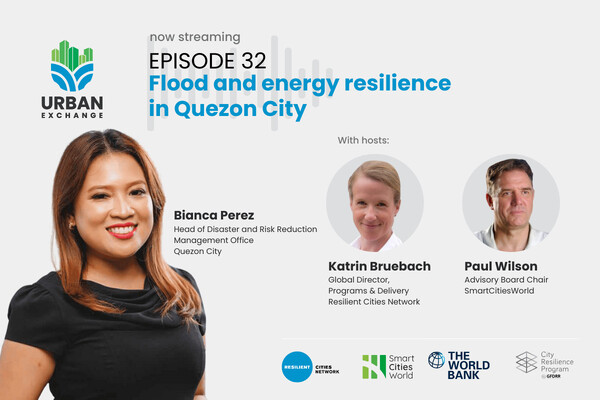
Urban Exchange Podcast Episode 32 – Flood and energy resilience in Quezon City
Tune in for the latest Urban Exchange where we get a first-hand account of city resilience measures from Quezon City following unexpected extreme rainfall.


In this episode of The Urban Exchange, hosts Paul Wilson and Katrin Bruebach speak with Bianca Perez, Head of the Disaster Risk Reduction and Management Office for Quezon City in the Philippines – a city that, in August 2025, experienced an extreme flooding event where the equivalent of five days of rain fell in just one hour.
Bianca explains how Quezon City, the most populous city in the Philippines and part of the wider Metro Manila area, is grappling with more frequent and intense rainfall, legacy urbanisation, and an overstretched drainage system. She shares how the devastating 2009 floods led to a national disaster risk framework, and how the city has since been trying to adapt – with mixed results.
The conversation dives into the critical interdependence of water and energy systems: you need power to pump and treat water, but water is also essential to keep energy systems running. When one fails, the other often follows. Using Quezon City’s experience, the episode explores what happens when national infrastructure projects are misaligned with local plans, including pumping stations that are built but not powered, poorly placed structures that worsen flooding, and a lack of systemic, cross-sector planning.
Bianca also opens a window into the human and operational side of disaster response: command-centre decision-making with only minutes of warning, coordinating rescues and evacuations for thousands of people, and the toll on responders who work through days of continuous crisis.
Finally, the episode looks ahead to energy resilience and clean energy transition in Quezon City – from reliance on generators toward a more integrated approach involving sensors, renewable energy, energy-efficient buildings, and a citywide resilience roadmap.
This is a candid, ground-level account of what climate-driven flooding really means for a major city – and what it will take to build resilient, energy-smart urban systems.
*This episode was recorded on 12 September, just under two weeks after the extreme weather event discussed hit Quezon City
Why not try these links to see what our SmartCitiesWorld AI can tell you.
(Please note this is an experimental service)
How can integrated water and energy systems improve urban flood resilience?What role do renewable energy sources play in Quezon City's disaster response?How does cross-sector planning reduce the impact of extreme rainfall events?What strategies enhance operational efficiency in emergency command centers?How can energy-efficient buildings contribute to a citywide resilience roadmap?climate actionClimate change/ResilienceEnergy & EnvironmentGovernance and CitizenPlanningPolicy MakingPublished PodcastRenewablesresilienceurban space
Latest City Profile
SmartCitiesWorld Newsletters (Daily/Weekly)
You may also like these related articles...
BECOME A MEMBER
© 2026 SmartCitiesWorld
Smart Cities World Ltd, 27 Clements Lane, London, EC4N 7AE