


BUILD YOUR OWN
RESOURCE LIBRARY



Opinions

Transforming indoor public safety with smart sensor networksSponsored by Motorola Solutions

How AI will define cities and mobility in 2026Sponsored by ST Engineering
COP30 Webinar Week (10 - 14 Nov): How cities are taking decisive climate action
As the world prepares for COP30 in Brazil, SmartCitiesWorld will host a dedicated COP30 webinar week focused on how cities are taking decisive climate action.
Running during the first week of COP30, the series will bring together global city leaders, practitioners, and innovators to discuss practical approaches to building more resilient, sustainable, and liveable urban environments.
This initiative forms part of SmartCitiesWorld’s ongoing Cities Climate Action campaign, which highlights best practices and emerging trends in how cities are responding to climate risks. The campaign explores themes including energy transition and efficiency, the built environment, and urban mobility through the lenses of policy development, technology implementation, and climate finance – as well as urgent challenges such as heat, extreme weather, and air quality. With cities on the frontline of climate impacts and opportunities, the campaign emphasises how local governments are driving progress and delivering solutions that matter to citizens.
The webinar topics were chosen by city leaders themselves. At this year’s Cities Climate Action Summit, SmartCitiesWorld invited participants to vote on the areas they see as most pressing for accelerating urban climate action. The six most popular themes now shape the COP30 webinar week agenda:
- Climate risk by design: embedding resilience in urban projects
- Unlocking climate finance: building city capacity and partnerships
- Smart nature: intelligent solutions for greener cities
- Resilient transit: stronger, safer, smarter networks
- Powering the future: energy innovation for people and planet
- Circular cities: retain, repurpose, reuse
Each session will provide wider industry context, highlight real-world examples from leading cities, and explore the tools, technologies, and strategies available to practitioners today. Together, they create a practical and forward-looking programme designed to help city leaders share knowledge, build capacity, and connect with peers at a pivotal moment in global climate action.
10 November 2025: Resilient transit: stronger, safer, smarter networks
Urban mobility is at the core of sustainable city strategies, but public transport systems face growing challenges from climate change, population growth, and safety concerns. Resilient and reliable networks are essential to reducing emissions while maintaining citizen trust in public transit as the backbone of urban mobility.
This webinar will look at how cities are strengthening transit systems through smart, data-driven approaches. It will explore innovations such as predictive maintenance powered by AI, IoT-enabled passenger safety systems, and digital twins for planning and resilience. Case studies will illustrate how smarter, safer networks are being built to withstand climate pressures and serve future generations.
11 November 2025: Powering the future: energy innovation for people and planet

Energy systems are the foundation of climate action, but cities need new approaches to balance technical innovation with social equity and environmental resilience. The energy transition now spans everything from advanced renewables and smart grids to nature-based cooling and community engagement programmes.
This webinar will examine how cities are creating energy systems that are both innovative and people-centred. It will highlight how digital tools, IoT-enabled efficiency platforms, and AI optimisation are driving progress, alongside community-focused initiatives that ensure inclusivity in the transition.
12 November 2025: Climate risk by design: embedding resilience in urban projects
Cities around the world are rethinking how infrastructure and urban planning can be made fit for a rapidly changing climate. From rising temperatures to extreme weather, resilience is becoming a foundational element of smart and sustainable city strategies. Embedding climate risk into early-stage decision-making ensures projects are not only compliant with new policy requirements but also futureproofed for the decades ahead.
This webinar will explore how climate risk assessments are reshaping the way cities approach planning and development. It will highlight the technologies that make this possible – from digital twins and predictive analytics to IoT-enabled monitoring – and showcase practical approaches cities are using to embed resilience into urban projects.
13 November 2025: Unlocking climate finance: building city capacity and partnerships
Financing remains one of the biggest challenges for climate action in cities. While the ambition is high, many local governments face barriers in accessing funds, building institutional capacity, and managing investment effectively. For smart cities, strengthening financial governance and transparency is critical to scaling projects that deliver meaningful change.
This webinar will examine how cities can expand their fiscal and institutional capacity to attract and manage climate finance. It will explore the role of digital tools for tracking and reporting, data platforms for transparency, and innovative approaches that allow cities to unlock new sources of investment.
14 November 2025: Smart action: intelligent solutions for greener cities
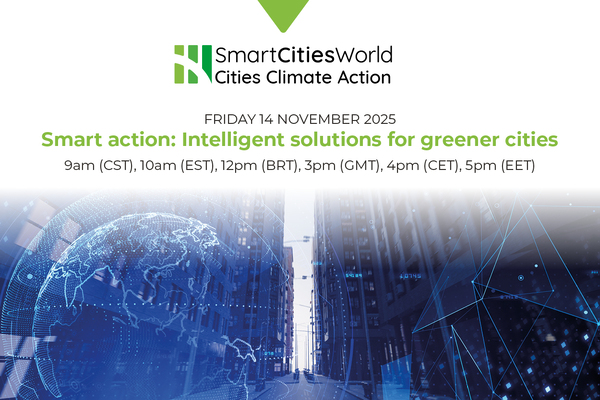
Nature-based solutions are gaining momentum as vital tools for cities seeking both climate resilience and improved liveability. What was once seen as purely ecological is now being augmented with digital intelligence, creating measurable, scalable, and investment-ready projects. For smart cities, the opportunity lies in combining green infrastructure with technology to deliver co-benefits like cooling, biodiversity, and public health.
This webinar will explore how intelligent nature-based solutions are being deployed in cities, from IoT-enabled green roofs to AI-powered stormwater management. It will highlight how these solutions are monitored, optimised, and integrated into wider urban strategies, and what practitioners can learn from global examples.
Why not try these links to see what our SmartCitiesWorld AI can tell you.
(Please note this is an experimental service)
How can AI-driven predictive maintenance improve resilience in urban transit networks?What digital tools best support transparent climate finance management in cities?How do IoT-enabled systems enhance safety and efficiency in public transportation?Which technologies effectively embed climate risk into early urban planning stages?How are intelligent nature-based solutions integrated with digital monitoring platforms?BECOME A MEMBER
© 2026 SmartCitiesWorld
Smart Cities World Ltd, 37 Lombard Street, London, EC3V 9BQ