












 22 - 26 June 2026: Find out more



BUILD YOUR OWN
RESOURCE LIBRARY



Podcasts

Cities Thriving on Lighting, Episode 2 – Simplicity by design in smart lightingSponsored by Paradox Engineering
Cities Thriving on Lighting, Episode 1 – Lighting as the backbone of the smart citySponsored by Paradox Engineering
Opinions

Transforming indoor public safety with smart sensor networksSponsored by Motorola Solutions
Air taxi start-up completes ‘transition’ flight over China
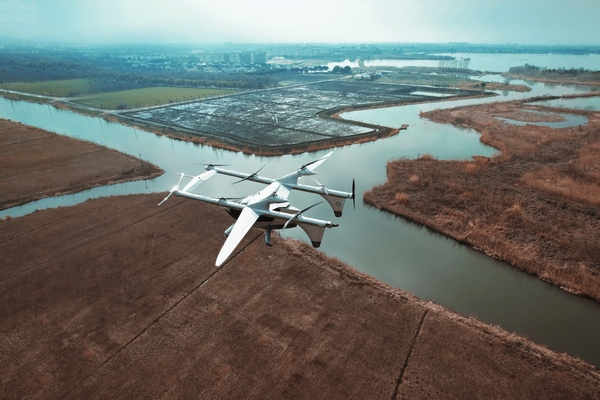
During the test flight, AutoFlight’s aircraft – capable of carrying three passengers – switches from a vertical take-off motion to the more energy-efficient, horizontal flight and back to vertical flight, before landing.


Electrical vertical take-off and landing (eVTOL) start-up AutoFlight has completed a proof-of-concept, transition test flight for its air taxi Prosperity I over China.
During the test flight, the aircraft – capable of carrying three passengers – switches from a vertical take-off motion to the more energy-efficient, horizontal flight and back to vertical flight, before landing.
The unmanned flight took place at AutoFlight flight test area in JiangSu province with Prosperity I rising to an altitude of 150 metres at speeds of up to 123mph.
Short city transfers
Prosperity I was designed for short transfers between parts of a city, airport commutes, connecting two nearby cities or enabling trips to the countryside while avoiding traffic on the ground. When ready for commercial flight in 2025, it is expected that a trip that takes hours by car will be reduced to about 10 minutes with Prosperity I, without being any more expensive than a car taxi ride.
Vertical flight for the proof-of-concept for Prosperity I required eight rotors to lift the electric aircraft into the air. Once the aircraft reached an altitude of 150 metres and an airspeed of 100-110mph, the fixed wing part of the eVTOL generated lift.
“The simplicity of design lies in our patented ‘lift and cruise’ configuration...making it affordable to manufacture, maintain and operate as an air taxi”
At this point, AutoFlight reports that Prosperity I entered the complex transition phase: the rotors on the top stopped spinning and locked in a streamlined position, while the propellers on the rear pushed the aircraft forward like a traditional fixed wing plane.
“The team and I are thrilled to have cracked the smooth transition phase of eVTOL flight, unlocking the skies for Prosperity I and our commercial products,” said AutoFlight CEO Tian Yu, who has over two decades of experience designing and building electric aircraft, and 300 electric aviation-related patents. “We are confident we have a good design underpinned by sound engineering, and delighted to see that the transition was smooth, safe and seamless.”
Read More
The milestone is the latest of significant recent developments for AutoFlight including: the establishment of a European base in Augsburg, Germany; the appointment of Mark Henning (formerly of Airbus) as its European managing director; and $100m investment from next-generation mobility investor Team Global.
“Achieving a smooth transition phase in record time, from prototype to flight, underlines the calibre of the engineering team we have at AutoFlight and gives great confidence as we progress into the development phase and layout plans for our first manned aircraft, the Prosperity I,” said Mark Henning, managing director, AutoFlight Europe.
“The simplicity of AutoFlight’s design lies in our patented ‘lift and cruise’ configuration, which combines superior range and safety with low technical complexity, making it affordable to manufacture, maintain and operate as an air taxi.”
AutoFlight uses artificial intelligence, autonomous driving and 5G with the aim of driving developments in the eVTOL industry.
Why not try these links to see what our SmartCitiesWorld AI can tell you.
(Please note this is an experimental service)
How does the 'lift and cruise' design improve eVTOL flight efficiency?What role does AI play in AutoFlight's autonomous air taxi operations?How does Prosperity I reduce travel time compared to traditional cars?What safety features enable smooth transition between vertical and horizontal flight?How will 5G connectivity enhance the performance of AutoFlight's eVTOLs?
Latest City Profile
Latest Urban Exchange Podcast
Latest Special Report
SmartCitiesWorld Newsletters (Daily/Weekly)
You may also like these related articles...
BECOME A MEMBER
© 2026 SmartCitiesWorld
Smart Cities World Ltd, 37 Lombard Street, London, EC3V 9BQ