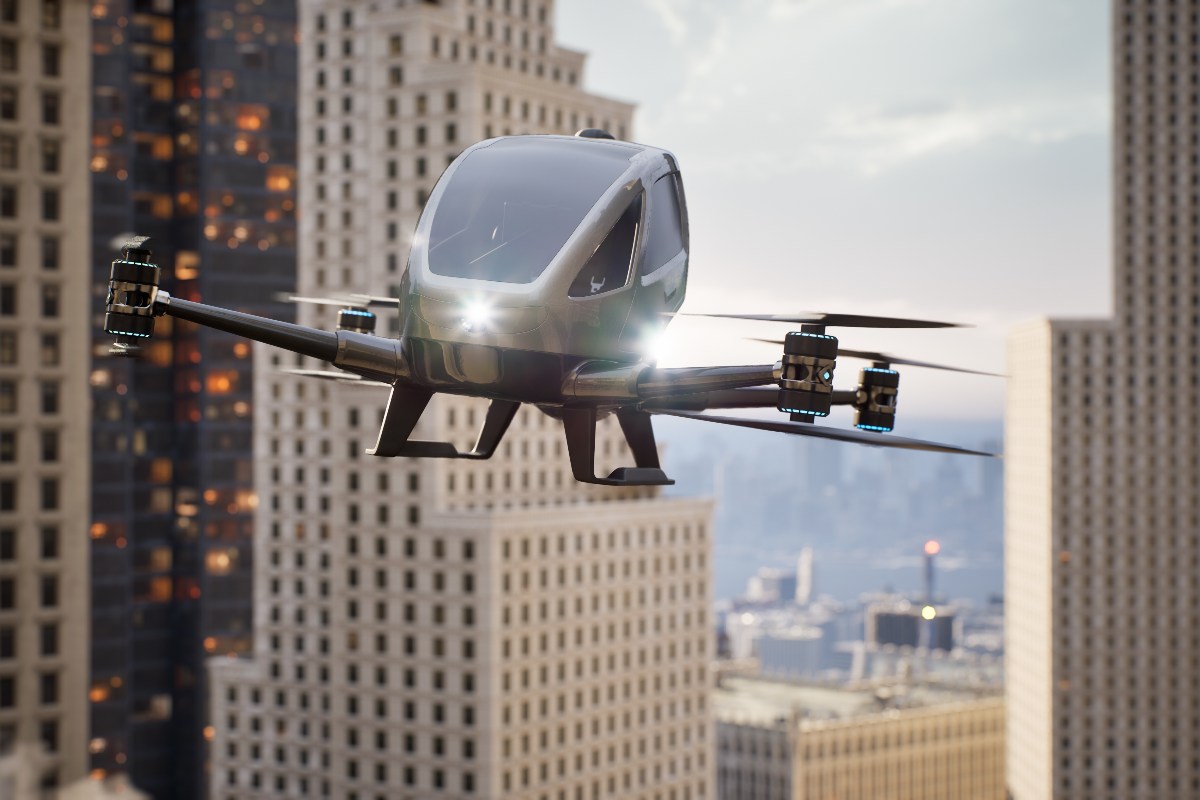










SmartCitiesWorld senior editor Luke Antoniou investigates the steps that cities, air mobility technology specialists and regulators are taking to enable urban air mobility to become a genuine solution for the transportation of people and goods.
The urban mobility sector is being disrupted by technology more now than at any other time in its history. One of the most exciting developments in the last five years has been the emergence of advanced air mobility services and vehicles to launch into urban environments, providing potential new mobility alternatives for both passengers and goods.
With pilots launching around the world to test the safety and myriad applications of new vehicles and technology, the overarching question is whether these services can truly form a new part of existing transportation networks in cities, and become part of the everyday urban landscape.
In cities around the world, authorities are taking steps to introduce urban air mobility pilots. Perhaps the most crucial aspect to this is the infrastructure that is needed to safely trial these new modes of transportation.
For many, it is a case of using existing infrastructure as testing areas for new vehicle types, such as eVTOLs. In November 2021, one such test area opened on the outskirts of Paris, with a consortium of aviation and transportation companies coming together to set up a test centre at the Pontoise-Cormeilles airfield. Testing at the site is being conducted to study the potential of launching two advanced air mobility routes to run during the 2024 Paris Olympics – one from the Paris-Issy-les-Moulineaux heliport to Saint-Cyr airfield, the second from Paris-Charles de Gaulle and Le Bourget airports to the city of Paris.
Not long after the Paris announcement, Dubai – whose Roads and Transport Authority (RTA) signed a five-year agreement with eVTOL manufacturer Volocopter in 2017 to regularly test autonomous air taxis – also announced its intentions to “create an advanced infrastructure to enable innovators and relevant entities to test prototypes of unmanned aerial vehicles in designated areas and develop legislation that optimises their implementation”.
With its Volocopter tests beginning in Q4 of 2017, Dubai was one of the early leaders in the advanced urban air mobility space. At the point of beginning trials, Dubai’s RTA ambitiously committed to making a quarter of all local traffic – both road and aerial – autonomous. A few years down the line, the emirate is looking to make good on its ambitions, announcing in November 2021 that it would launch a programme to develop unmanned drone transportation systems. Unlike some of the global competition, the programme is set to explore beyond the realms of passenger transport, expanding into health, security, shipping and food sectors.
Sheikh Hamdan explained at the time: “The Dubai Programme will create an advanced infrastructure to enable innovators and relevant entities to test prototypes of unmanned aerial vehicles in designated areas and develop legislation that optimises their implementation. The program aims to provide new economic opportunities and consolidate Dubai’s leadership in advanced technology research and development across diverse future-oriented sectors.” He added, “We have the right environment, infrastructure, and legislation for the use of drones. We also have the laboratories, expertise and talent to translate prototypes into viable solutions.”
It is not only the world’s megacities exploring urban air mobility applications, however, with local authorities seeking to prove that eVTOL vehicles can play a role in everyday mobility in cities with varying needs. One of the most prominent examples to date is the UK city of Coventry which will play host to the world’s first electric urban airport – Air One – following infrastructure specialist Urban-Air Port’s selection as winner of the UK government’s Future Flight Challenge.
While cities such as Paris are using existing infrastructure to launch and scale UAM pilots, Coventry’s Air One will act as a fascinating new case study at launch, being the first electric, dedicated UAM airport in the world. Coventry was chosen as the launch site for its convenient location at the centre of the UK, being within four hours of most parts of the country. The city is also a UK leader in electric car adoption, with Air One set to build on those foundations with autonomous and zero-emission urban flight. Jim O’Boyle, a Coventry city councillor, said that the city’s work with Urban-Air Port “highlights how the council is working alongside a range of organisations to help shape a better, greener future.”
Urban-Air Port is just one of several frontrunners in the urban air mobility space that are developing technology, infrastructure and vehicles for this next step in urban transport. Whether it’s new or updated airspace management software, bespoke infrastructure or brand-new, drone-like eVTOL vehicles, technologists and innovators are working day and night to deliver a future vision of mobility unlike any we’ve seen before in our cities.
At the heart of the developments are safety and sustainability, meaning that services and infrastructure need to be electric, zero emission and completely safe for citizens and operators alike if advanced urban air mobility is to transition from a series of global trials to everyday commercial services.
Not only are new ventures and start-ups exploring the opportunities in UAM, so too are established OEMs and vehicle manufacturers, resulting in a wide range of partnership possibilities and knowledge sharing collaborations. For example, Urban-Air Port was selected in 2021 as the priority partner of Hyundai Motor Group’s Urban Air Mobility Division. Together, the companies will create 65 new electric urban air ports created around the world, following in the footsteps of Coventry’s Air One.
Alongside the established OEMs and start-ups are the likes of nation agencies, stretching even as far as NASA which began flight testing late in 2021 with Joby Aviation’s eVTOL aircraft as part of the agency’s Advanced Air Mobility (AAM) National Campaign. Joby’s focus is on electric aerial ride-sharing applications for a range of communities, leveraging the minimal space that eVTOL vehicles require to take off and land to demonstrate potential ease of adoption in urban areas.
Key to the testing of this technology is the collection and analysis of data to be able to better integrate services and vehicles into cities and urban airspace in the future. During the NASA and Joby test flights, for example, NASA collected data not only on how the vehicle moved and communicated with controllers, but also how it sounds. The vehicle was fitted with an array of over 50 microphones to measure its acoustic profile in different phases of flight. All of the collected data could then be used to model and simulate future airspace concepts, also addressing gaps in existing policy and regulation that needs to be addressed before UAM services can launch fully.
The range of applications that urban mobility services could have across the urban landscape lend themselves to scrutiny from legislators and regulators from a range of different industries across both the public and private sectors.
Perhaps the most significant hurdle is building confidence and trust with regulators, passengers and users. Without clearing this barrier, operators of these new mobility services will not be able to scale their offerings to become a genuine part of the urban mobility mix.
In 2021, the European Union Aviation Safety Agency (EASA) conducted research into the public perception of urban air mobility services launching in various guises throughout Europe in the next three to five years. Encouragingly, 83 per cent of respondents to the survey expressed a positive attitude to UAM, with 64 and 49 per cent, respectively, saying they were ready to try drones and air taxis. Respondents also showed strong support for UAM applications that would provide value to a majority of people, for example, transporting injured people to hospital or delivering medical supplies to hospitals using drones.
Unsurprisingly, respondents also categorically said that they’d expect UAM operations to be as safe as current aviation operations, demonstrating that there is concern that the vehicles and services are viewed differently to more traditional air travel services. Safety was the top concern for respondents, whether responding about air taxis or drones, as they also indicated that they would prefer to limit their own exposure to UAM in their own cities.
When it comes to European policy, eVTOL aircrafts will need to be certified to the highest safety standards as provided by EASA, which exceed the safety levels of drones, helicopters or conventional aircraft to be able to fly above congested areas, such as cities.
As with launching any new mobility service, each city will have its own needs and requirements that operators will need to meet. While there are minimum flight heights to consider – as shorter trips within the same city will prevent aircraft from reaching the specified minimum height in ICAO’s Rules of the Air – local authorities are able to decide on whether to alleviate height and route restrictions for UAM.
The goal for many eVTOL operators is to launch unmanned services, but this process will need to be managed iteratively, with initial services launching with pilots – akin to safety drivers in connected and autonomous road vehicles.
Considering the potential benefits of urban mobility applications, innovators and operators will work closely with cities and regulators to ensure that these hurdles are overcome. However, part of the human condition is to fear the unknown; it is trust and belief in UAM from a citizen’s perspective that will ultimately make or break this new form of mobility, and determine whether it is able to form part of a fully integrated urban mobility network.
Why not try these links to see what our SmartCitiesWorld AI can tell you.
(Please note this is an experimental service)
How can existing infrastructure support urban air mobility pilot programs?What safety standards must eVTOL aircraft meet for urban operations?How do data collection efforts improve integration of UAM into cities?What roles do regulators play in advancing urban air mobility adoption?How can urban air mobility contribute to emergency medical transport?