








 22 - 26 June 2026: Find out more



BUILD YOUR OWN
RESOURCE LIBRARY



Podcasts
Cities Thriving on Lighting, Episode 2 – Simplicity by design in smart lightingSponsored by Paradox Engineering
Cities Thriving on Lighting, Episode 1 – Lighting as the backbone of the smart citySponsored by Paradox Engineering
UK town creates digital twin to help deliver net zero future
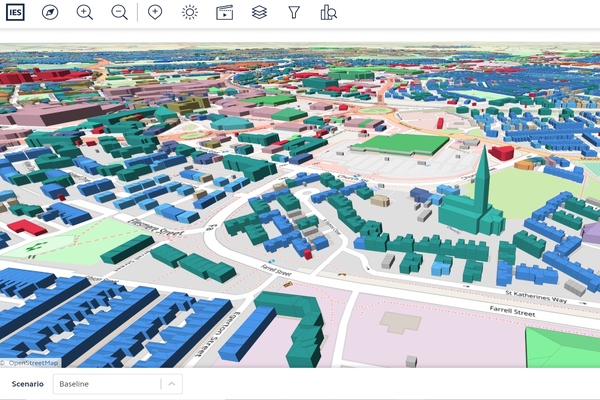
Digital twin model of Warrington is made up of 29 separate areas and aims to identify energy, carbon and cost-efficiency pathways to deliver a net-zero future.


The UK town of Warrington in northwest England has developed a digital twin to help identify the energy, carbon and cost-efficiency measures required across its buildings and energy systems to deliver a net-zero future.
The town worked with consultants from climate technology firm IES on the project, which is part of the Rewire programme, funded by the UK innovation agency Innovate UK.
Climate emergency
The project to identify the data-informed pathways to net-zero was led by charity Pure Leapfrog with input from Warrington Borough Council. Warrington Borough covers an area of 70 square miles in the northwest of England between the cities of Manchester and Liverpool and is home to around 200,000 residents. The council declared a climate emergency in 2019 and is working on a variety of initiatives to shape and guide its journey towards net-zero emissions.
The digital twin model of the borough is made up of 29 separate areas and was created using data from various sources including the council itself, the Energy Performance Certificate (EPC) database, and local distribution network operators.
The various data streams fed into the development of the digital twin and included details such as geolocated building geometry, building use and age, building characteristics and electric network infrastructures.
“Using the model to full effect will allow the council to see various possible optimisation scenarios and understand the potential return on investment for associated decarbonisation initiatives”
The information from each of the 29 areas was individually modelled in IES’ masterplanning and urban design tool, Intelligent Community Design (iCD). This analyses and monitors how the community may evolve over time and tracks the environmental impact of any changes such as population growth, the installation of renewable energy systems and changes to the massing and form of buildings.
These 29 models were then collated into one single digital twin hosted on IES Intelligent Community Information Model (iCIM) platform, which connects each of its digital twin simulation tools.
Read More
Using EPC data to gather information on 50,000 residential properties within the borough, including build characteristics, age band, main heating system and gross floor area, archetype models were created of four main types of homes: detached houses; semi-detached houses; terraced houses; and apartments.
These models were then used to create a holistic view of the area integrating electricity, heating, cooling, waste heat networks and shared energy links across buildings. From this, supply and demand from buildings and community assets were assessed to determine the flexibility required across the study area to balance demand and evaluate “what if” scenarios for intelligent operation.
Decarbonisation
Using the results for three different retrofit scenarios, approaches for full decarbonisation of the district, were simulated. This was initially assessed for two different neighbourhoods of around 500 homes and potential energy savings of up to 56 per cent were identified.
The most optimal solutions for decarbonising were found for each area. In one neighbourhood, the basic retrofit, following the installation of district heating, air source heat pumps and mass PV and community storage, would result in a 41 per cent annual energy cost saving, worth £583 per household. The maximum retrofit scenario along with the same interventions would see a 56 per cent reduction in energy costs per year, equivalent to £795 per household at the time the simulations were run in 2020.
The overall cost of the interventions would be £2m to £5m per neighbourhood depending on the retrofit scenario, but this didn’t take district heating systems, domestic heat pumps or EV chargers into account, which could all add to costs significantly.
Using the digital twin simulation of two neighbourhoods within the borough, it was demonstrated that once all interventions were applied, an annual saving of 2,000-2,500 tonnes of CO2 would be possible. This would result in both these neighbourhoods becoming net zero with only a very small amount of carbon offsetting required.
“These models are easily replicable to any UK city and hold a huge amount of potential in bolstering the country’s progression towards net-zero, so we really hope to see more councils implementing this kind of technology”
“A shared central database and interconnected tools have allowed data and analysis to be easily shared between key stakeholders within this project, laying out some pathways for potential future decarbonisation,” said councillor Janet Henshaw, Warrington Borough Council, cabinet member for sustainability and climate change.
She added: “Using the model to full effect will allow the council to see various possible optimisation scenarios and understand the potential return on investment for associated decarbonisation initiatives.”
Fergus Ross, ICL project manager at IES, said: “Working with Warrington Borough Council on the Rewire North West project has shown how we can quantify energy-saving measures and support local councils in seeking to secure investment in decarbonisation initiatives. These models are easily replicable to any UK city and hold a huge amount of potential in bolstering the country’s progression towards net-zero, so we really hope to see more councils implementing this kind of technology.”
Why not try these links to see what our SmartCitiesWorld AI can tell you.
(Please note this is an experimental service)
How does the digital twin model optimize energy efficiency across Warrington's buildings?What data sources are integrated to create Warrington's digital twin model?How do retrofit scenarios impact carbon reduction in Warrington neighborhoods?In what ways can the digital twin support investment decisions for decarbonisation?How does the digital twin simulate community energy demand and supply flexibility?climate actionClimate change/ResilienceConnectivity & Datadigital twinsEnergy & EnvironmentIESRenewablesWarrington Borough Council
Latest City Profile
Latest Urban Exchange Podcast
SmartCitiesWorld Newsletters (Daily/Weekly)
You may also like these related articles...
BECOME A MEMBER
© 2026 SmartCitiesWorld
Smart Cities World Ltd, 37 Lombard Street, London, EC3V 9BQ