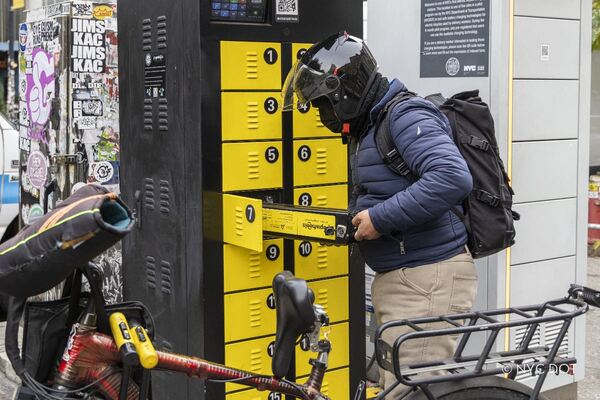








The e-bike battery swapping cabinets provide safe charging stations where electric micromobility users can plug in dead batteries and pick up full ones.
At a glance
Who: New York City Department of Transportation (NYC DoT); Fire Department of the City of New York (FDNY).
What: NYC DoT has launched a public portal inviting residents to help determine locations for e-bike battery swapping cabinets across New York City.
Why: To provide safe charging stations where electric micromobility users can plug in dead batteries and pick up full ones. In particular, they support delivery workers, who – without access to battery swapping – often have to carry multiple heavy batteries to last a full shift.
When: NYC DoT aims to bring power to the finalised locations with cabinets available for use starting in 2028.
New York City Department of Transportation (NYC DoT) has launched a public portal inviting residents to help determine locations for e-bike battery swapping cabinets across New York City.
E-bike battery swapping cabinets provide safe charging stations where electric micromobility users can plug in dead batteries and pick up full ones.
According to transportation officials, the infrastructure, which is available to all New Yorkers, is essential for delivery workers, who – without access to battery swapping – often have to carry multiple heavy batteries to last a full shift.
“We’re building a city around the people who live and work here – their jobs, their dreams, their lives reflected in the infrastructure we invest in,” said mayor Zohran Kwame Mamdani.
“These e-bike battery swapping cabinets are about supporting workers, making our city safer and embracing the kinds of transportation New Yorkers are already turning to in growing numbers. I’m proud to help bring New Yorkers’ voices into this citywide rollout, and I’m eager to see how people shape it through the public portal.”
“E-bikes are an efficient, sustainable way to get around the city – and thousands of delivery workers rely on them every day”
The City’s battery swapping cabinets are designed to mitigate the risk of fires caused by lithium-ion e-bike batteries, which are often linked to the use of uncertified or low-quality batteries, improper charging in residential buildings, lack of safe storage spaces and educational gaps around safe battery handling.
Each cabinet will include batteries that meet the highest fire safety standards set by the Fire Department of the City of New York (FDNY), encourage the use of certified batteries and build confidence in the safety of e-bike charging across the city. Cabinets will be weather-resistant, theft-proof and fire-proof structures as well as include battery health monitoring and fire suppression systems.
NYC DoT and the FDNY will work in tandem to ensure all cabinets and batteries are properly certified to applicable UL standards and that all sites meet required clearances prior to installation.
To support this effort, the FDNY is extending the filing deadline for the outdoor installation of grandfathered charging cabinets under the letters of no objection programme through September 2026.
“We’re building a city around the people who live and work here – their jobs, their dreams, their lives reflected in the infrastructure we invest in”
“E-bikes are an efficient, sustainable way to get around the city – and thousands of delivery workers rely on them every day,” said NYC DoT commissioner Mike Flynn. “These battery swapping cabinets will make charging safer and more accessible on the job. We’re also inviting New Yorkers to weigh in through a new portal to help us place them where they’ll work best and have the biggest impact.”
In 2024, NYC DoT conducted a successful six-month public e-bike battery charging pilot, which concluded that the cabinets were safe, well-used and convenient for delivery workers. Pilot participants reported that the battery-swapping services allowed them to complete more deliveries during a shift.
NYC DoT will review the public’s comments on the preliminary sites, refine the list of locations based on this input and develop a prioritised list of approximately 25 locations to initiate the project’s design phase. NYC DoT aims to bring power to the finalised locations with cabinets available for use starting in 2028.