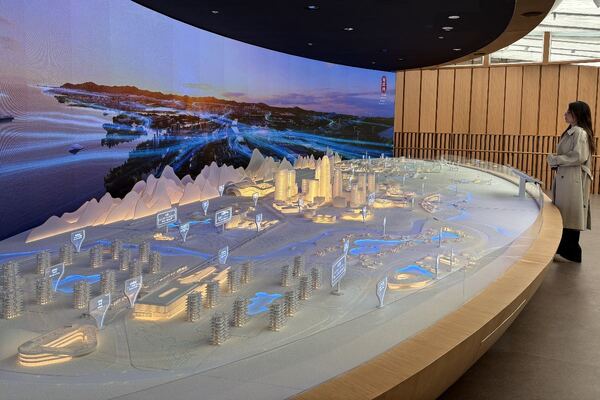


The Smart Future City exhibit is centered around an eight-network integrated future city development, emphasising immersion, interactivity, and engagement.
China Energy Engineering Corp (CEEC) is showcasing its eight-network integrated future city development solution in the China Pavilion at Expo 2025, which opened on 13 April in the Japanese city of Osaka. It will run for six months until 13 October.
Under the theme Designing Future Society for Our Lives, Expo 2025 has attracted participation from over 150 countries, regions and international organisations.
CEEC said its Smart Future City exhibit highlights latest milestones in “Chinese-style modernisation” and contributes to a global vision for sustainable development in collaboration with countries around the world.
The China Pavilion, one of the largest foreign self-built pavilions in terms of land area, is themed Building a Community of Life for Man and Nature – Future Society of Green Development.
In the Endless Vitality exhibition section of the pavilion, CEEC’s smart city display is centered around its eight-network integrated future city development solution. Closely aligned with the future society theme, the exhibit emphasises immersion, interactivity, and engagement.
“Through ongoing fusion, transformation, and iterative upgrades, the solution enables these networks to deeply integrate, interact, and coexist, thereby enhancing the city’s economic efficiency, ecological resilience, and cultural vitality in multiple dimensions”
Using model sand tables, 3D video, interactive multimedia, and other methods, the company has created a thematic light show that fuses digital innovation, green revolution, and cultural heritage. The presentation aims to showcase China’s applications in frontier technologies such as clean energy, artificial intelligence, smart transportation, zero-carbon buildings, and low-altitude economy.
CEEC’s eight-network future city development solution systematically integrates eight elements: the energy network, transportation network, digital network, water network, ecological network, industrial network, health network, and cultural network.
“Through ongoing fusion, transformation, and iterative upgrades, the solution enables these networks to deeply integrate, interact, and coexist, thereby enhancing the city’s economic efficiency, ecological resilience, and cultural vitality in multiple dimensions,” said Song Hailiang, board chairman and executive director of CEEC and added that the company is committed to “building livable, resilient, and smart cities”.
The solution features more than 10 clean energy technologies, including marine energy integration, compressed air energy storage power stations, high-altitude wind power generation, and solar thermal power.
In Yingcheng, Hubei province, CEEC has put into operation what claims to be the world’s first 300-megawatt compressed air energy storage demonstration project. In Songyuan, Jilin province, the company’s investment in the world’s largest integrated green hydrogen-ammonia-methanol project is set to go into operation this year. Meanwhile, in Jixi county, Anhui province, CEEC has generated electricity with the country’s first grid-connectable megawatt-level high-altitude wind power demonstration project.
The company is also developing a series of projects that fully tap into energy area, including wind power, photovoltaic power, solar thermal power, nuclear power, hydrogen power.
Why not try these links to see what our SmartCitiesWorld AI can tell you.
(Please note this is an experimental service)
How does CEEC's eight-network integration improve urban economic efficiency?What clean energy technologies are included in CEEC's smart city solution?How does the smart city model enhance ecological resilience in urban areas?In what ways does AI support connectivity within CEEC's future city networks?How are parks and green spaces incorporated into CEEC's urban planning?