






Los Angeles Cleantech Incubator and the Cambridge Innovation Centre will lead the design and operation of the BATWorks climate innovation hub in Sunset Park.
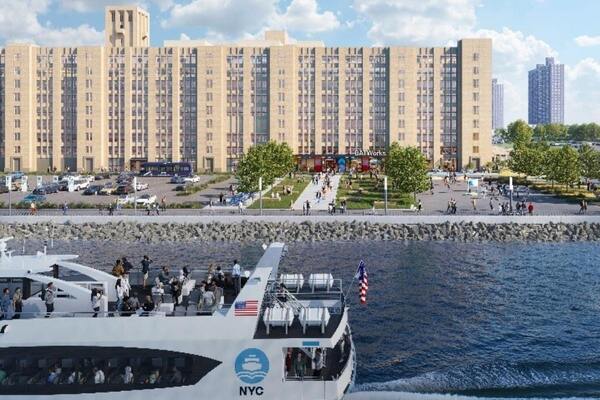
A consortium led by the Los Angeles Cleantech Incubator (LACI) and the Cambridge Innovation Centre (CIC) will design and operate the BATWorks, climate innovation hub at the Brooklyn Army Terminal (BAT) in Sunset Park.
The hub will provide start-ups with space for product research and development, as well as offer workforce training and job placement programming to New Yorkers.
LACI – a cleantech incubator created as an independent nonprofit organisation by the City of Los Angeles – will advise on climate programming and lead the Pilots at BAT programme, which enables emerging climate technology companies to test their products in a live built environment.
With the selection of LACI, New York City mayor Eric Adams aims to strengthen the relationship between the nation’s two largest cities on climate innovation and help grow the climate technology landscape, driving investment, jobs, commercialisation, and equitable economic opportunity in both cities.
“We will create transformative technologies at Sunset Park, support hundreds of ‘green-collar’ jobs, and work across the public and private sector to build a more sustainable future for our city and our country”
Additionally, CIC, a global specialist in building and operating innovation campuses will design work and laboratory spaces as well as programming to support innovation and attract start-ups. The awarded consortium also includes The City University of New York (CUNY), New York University (NYU) and Perkins and Will.
New York City Economic Development Corporation’s (NYCEDC) $100m investment in BATWorks will aims to help create more than 600 jobs, serve 150 startups over 10 years, and generate $2.6bn in economic impact for the city.
BATWorks will continue mayor Adams’ efforts to turn New York City’s waterfront into a “Harbour of the Future” and support entrepreneurs and leaders developing, piloting, and deploying new solutions to combat climate change.
NYCEDC has also awarded $1.4m to the South Brooklyn Industrial Development Corporation to lead an Economic Mobility Network across Sunset Park, connecting local residents to good-paying jobs in innovative industries, such as life sciences and the green economy. Initial community partners in the Economic Mobility Network include Brooklyn Workforce Innovations, Opportunities for a Better Tomorrow, and Chinese American Planning Council. BATWorks and the Economic Mobility Network represent the city’s long-term investment to advance equitable economic growth in Sunset Park.
“For hundreds of years, New York City’s waterways have powered our economy, supported working-class jobs, and transformed our city into the economic engine of the world. Our administration is writing the next chapter in the long history of these waterways, seizing that legacy and creating a ‘Harbor of the Future’ all along our coast,” said mayor Adams. “We will create transformative technologies at Sunset Park, support hundreds of ‘green-collar’ jobs, and work across the public and private sector to build a more sustainable future for our city and our country.”
The roughly 200,000 square-foot BATWorks hub will provide a wide range of start-ups –including emerging market innovators, small- and- medium-sized companies, and growth-stage and commercialisation-stage companies – with fit-for-purpose space to build products, rapidly prototype new technology, and carry out product research and development. BATWorks will also provide workforce training in green-economy jobs to New Yorkers, with a particular focus on training individuals living in Sunset Park and in the surrounding communities.
“BATWorks, a cutting-edge climate innovation hub at the Brooklyn Army Terminal, will unlock new opportunities for startups and entrepreneurs, advance new innovative climate solutions, fuel job growth, and strengthen Brooklyn’s working waterfront – all while training New Yorkers of all backgrounds for green-collar jobs,” said NYCEDC president and CEO Kimball. “NYCEDC is proud to select two outstanding operators – including one in partnership with the city of Los Angeles – to design and launch this first-of-its-kind hub and grow an innovation ecosystem that will have a global impact.”
The Adams administration is partnering with LACI to bring its startup technology and business model piloting capabilities to BATWorks as well as advise on related climate innovation programmes.
Starting in January 2026, LACI will help pilot climate technologies as part of the Pilots at BAT programme, where climate technologies can be developed and scaled. BATWorks will also serve as the first semi-permanent test bed, or innovation sandbox, for LACI’s City Climate Innovation Challenge outside of Los Angeles, providing startups with a space to pilot their technologies in a live, urban environment.
“Climate innovation hub at the Brooklyn Army Terminal will unlock new opportunities for startups and entrepreneurs, advance new innovative climate solutions, fuel job growth, and strengthen Brooklyn’s working waterfront”
LACI’s Challenge currently works with nine cities and other partners – including C40, Climate Mayors, and the Rockefeller Foundation – on zero emissions delivery innovation, using models developed in Los Angeles and Pittsburgh. LACI’s programming at BATWorks will also create equitable workforce pathways for New Yorkers to access green-collar jobs and establish business development services, helping both startups and incumbent climate innovation businesses navigate regulations and reach commercialisation.
The Adams administration will also partner with CIC, an expert in building and operating flexible workspace. CIC will partner with the city to design the work and lab space as well as provide day-to-day management and operations of BATWorks, which will include cutting-edge facilities like prototyping labs and specialised testing platforms.
The awarded consortium also includes CUNY, NYU, including the Urban Future Lab at NYU Tandon, and Perkins and Will. CUNY and NYU will both deliver programming at BAT, including tie-ins with startup services, workforce development programmes, K-12 programs for New Yorkers from all backgrounds, and tech transfer to build a bridge between academic research and commercial industries. Perkins and Will will co-envision and design the co-working space and incubation facilities, as well as lab prototyping facilities and trial assembly facilities.
Why not try these links to see what our SmartCitiesWorld AI can tell you.
(Please note this is an experimental service)
How will BATWorks support rapid prototyping of emerging climate technologies?What workforce training programs will BATWorks offer to local New Yorkers?How does the consortium plan to integrate academic research with startups?In what ways will BATWorks contribute to equitable economic development?How will the Pilots at BAT program facilitate live urban environment testing?