







BUILD YOUR OWN
RESOURCE LIBRARY



Opinions
Smart lighting: enabling smart cities beyond illuminationSponsored by Paradox Engineering

How AI and biometrics are shaping next-generation mobility paymentsSponsored by ST Engineering
Finalists chosen to transform crowd management in sacred Indian city
Challenge supports innovative solutions to ease congestion and improve pedestrian and pilgrimage flows through Varanasi, one of India’s most sacred cities.


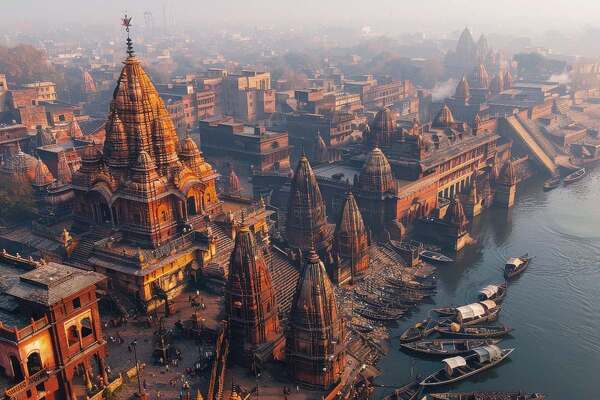
The Toyota Mobility Foundation has named the five finalists for the $3m Sustainable Cities Challenge, focused on transforming crowd management solutions in the historic city of Varanasi.
Developed in collaboration with the City of Varanasi, Challenge Works and World Resources Institute, the Challenge supports innovative solutions to ease congestion and improve pedestrian and pilgrimage flows through one of India’s oldest and most sacred cities, which welcomes millions of visitors each year.
Meaningfully changing crowd behaviour
The challenge attracted entries from innovators worldwide, with 10 semi-finalists being invited to further develop their concepts over a six-month period. From that group, five have now been selected as finalists following a rigorous evaluation from a panel of expert judges.
Finalists were chosen based on criteria including innovation in crowd management, effectiveness, supporting data, potential to scale and team capacity. Judges looked for solutions that could help support the management of large crowds, improve the safety, accessibility and navigability of narrow lanes, and meaningfully alter crowd behaviour – all while demonstrating a strong understanding of the needs of locals, tourists and the feasibility of implementation.
Each team was required to present a clear demonstration plan with measurable performance indicators to support long-term impact and scalability.
“Through the Sustainable Cities Challenge, Varanasi is setting a global example for how historic and pilgrimage cities can embrace innovation without compromising their identity”
The panel of five judges, bringing together expertise in data-driven technology, sustainable mobility and urban design, alongside deep knowledge of local business and community needs, selected the following finalists:
- Arcadis is the world’s leading company delivering intelligence-driven sustainable design, engineering and consultancy solutions for natural and built assets. The team’s integrated solution is called Sankalp, an ecosystem of interconnected technologies designed to shift from reactive measures to proactive, intelligent crowd management. Sankalp will use real-time data, advanced simulation, mobile technology and integrated communications platforms to keep people moving safely and efficiently
- CityData is a pioneering big data and AI company that delivers mobility intelligence to foster smarter, safer, more sustainable and resilient urban environments. The team’s solution is CityFlow, a cloud-based solution that uses big data, computer vision and generative AI to measure, analyse, simulate and manage crowds in real time. Built on the Masi framework, it delivers actionable insights without the need for new hardware
Read More
- Vogic AI is at the forefront of Vision AI for public good, transforming video data into real-time intelligence for smart cities, crowd-sensitive public spaces, and defence. Vogic AI’s solution is Behtar-Way, India’s first AI powered, hyperlocal community-first pedestrian navigation platform. The team’s solution will help guide citizens through safer, alternative routes, equipping city officials with real-time crowd intelligence
- Prameya Consulting is an urban planning and strategy firm that aims to drive urban transformation through collaborative problem-solving and strategic planning. The team’s solution is Nayichaal, a “phygital” (physical and digital) AI ecosystem combining a chatbot, navigation app, wayfinding signage and a mobility dashboard to improve mobility, inclusivity and safety
- The Urbanizer is a pioneering urban design, landscape design and architecture firm based in India. It specialises in creating vibrant, sustainable urban spaces through a data-driven and human-centric approach. The team’s solution is Jan Jatra, a people-first mobility solution blending local insights with color-coded wayfinding, dynamic digital signage and other tactical urbanism strategies to improve navigation and safety.
Each finalist team will receive $130,000 in implementation funding to demonstrate and test their proposed solutions in Varanasi.
“Through the Sustainable Cities Challenge, Varanasi is setting a global example for how historic and pilgrimage cities can embrace innovation without compromising their identity,” said Akshat Verma, IAS, municipal commissioner and chief executive officer, Varanasi Municipal Corporation/Varanasi Smart City.
“These five outstanding finalists are not only developing solutions that enhance safety, accessibility and the lived experience for both residents and pilgrims, but also ensuring they safeguard the cultural and spiritual fabric of Kashi [Varanasi] for future generations. We hope the world will look to Varanasi as a model for how tradition and technology can co-exist to create more liveable, resilient cities.”
“We’re excited to see how their solutions are implemented on the ground, not only to improve movement with convenient and safe access in Kashi, but to create a benchmark on how other heritage-rich, high-density cities around the world can tackle similar challenges”
Pras Ganesh, executive programme director, Toyota Mobility Foundation, added: “The Varanasi Sustainable City Challenge journey has been truly inspiring. From a field of global innovators, these finalists stood out for their creative, practical and contextual approaches to one of the world’s most complex mobility environments.
“As we move into the next phase, we’re excited to see how their solutions are implemented on the ground, not only to improve movement with convenient and safe access in Kashi [Varanasi], but to create a benchmark on how other heritage-rich, high-density cities around the world can tackle similar challenges with empathy and innovation.”
The Sustainable Cities Challenge is funded by the Toyota Mobility Foundation and has been designed in partnership with Challenge Works and World Resources Institute. It aims to create cleaner, more efficient urban mobility systems worldwide. The innovative approaches emerging from Varanasi’s Sustainable City Challenge demonstrate how locally grounded ideas can drive meaningful progress toward global sustainability goals.
In addition, Toyota Mobility Foundation works with Toyota Kirloskar Motor for amplification and on-ground support towards effective implementation of its various initiatives in India.
Why not try these links to see what our SmartCitiesWorld AI can tell you.
(Please note this is an experimental service)
How can AI-driven crowd management improve pedestrian safety in Varanasi?What role does real-time data play in reducing congestion during pilgrimages?How might digital wayfinding enhance accessibility in narrow urban lanes?In what ways can community-first navigation platforms support local residents?How can scalable crowd solutions balance heritage preservation with urban mobility?4GcongestionConnectivity & DataCultural spaceDataGovernance and CitizenmobilityPedestrianisationPeople and Skillsurban space
Latest City Profile
SmartCitiesWorld Newsletters (Daily/Weekly)
You may also like these related articles...
BECOME A MEMBER
© 2026 SmartCitiesWorld
Smart Cities World Ltd, 27 Clements Lane, London, EC4N 7AE