
















BUILD YOUR OWN
RESOURCE LIBRARY



Podcasts
Cities Thriving on Lighting, Episode 2 – Simplicity by design in smart lightingSponsored by Paradox Engineering
Cities Thriving on Lighting, Episode 1 – Lighting as the backbone of the smart citySponsored by Paradox Engineering
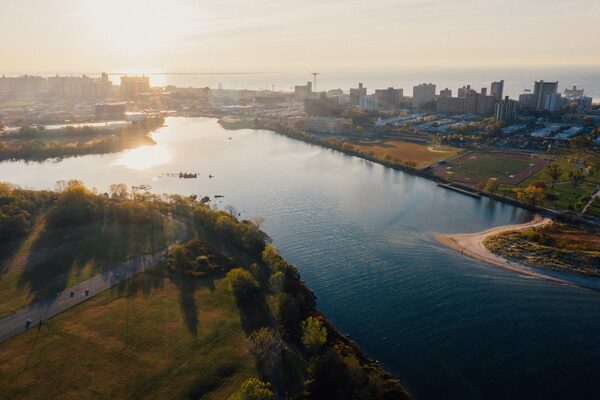
New York plans $95m flood protection project in Homecrest
This project turns everyday public spaces like schoolyards, streets and parking lots into green infrastructure to keep communities safe during storms.


 At a glance
Who: New York City Department of Environmental Protection (NYC Dep); NYC Parks; New York City Department of Transportation; New York City Public Schools (NYCPS).
What: New York City Department of Environmental Protection (NYC Dep) has announced $95m funding for a Cloudburst stormwater management project in Homecrest, Brooklyn.
Why: To reduce flooding, protect local waterways and strengthen neighbourhood resilience as extreme weather becomes more frequent and more severe.
Where: The project will target flooding hotspots across a 350-acre area, including Kings Highway, Coney Island Avenue and avenues P, R, S, T, U and V.
New York City Department of Environmental Protection (NYC Dep) has announced $95m funding for a Cloudburst stormwater management project in Homecrest, Brooklyn.
The project is designed to reduce flooding, protect local waterways and strengthen neighbourhood resilience as extreme weather becomes more frequent and more severe.
Neighbourhood-scale infrastructure
Cloudburst projects use a network of neighbourhood-scale infrastructure to move stormwater off streets during short, intense storms without overwhelming the sewer system. In Homecrest, Dep will install porous pavement on City streets and underground storage systems on public land, managing an estimated 30 million gallons of stormwater each year, according to Dep.
The Homecrest project will be built to handle the increasingly common, heavy downpours that can drop more than two inches of rain in a single hour.
“As climate change accelerates, investments like this are not optional. They are how we deliver a city that is resilient, equitable and prepared”
Dep reports the Homecrest project will relieve pressure on the sewer system during peak rainfall by capturing and storing stormwater before it floods streets or flows untreated into Coney Island Creek. Reducing polluted runoff is essential to protecting water quality and meeting Clean Water Act standards.
“We are building a city that protects New Yorkers in the places where flooding hits hardest,” said Zohran Kwame Mamdani, mayor of NYC. “This project turns everyday public spaces – our schoolyards, streets and parking lots – into infrastructure that keeps our communities safe. As climate change accelerates, investments like this are not optional. They are how we deliver a city that is resilient, equitable and prepared.”
Read More
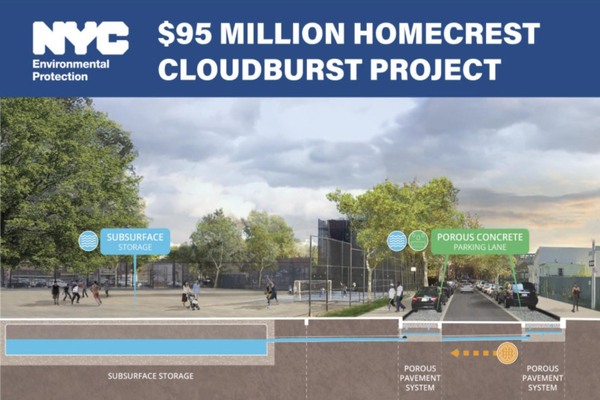
Cloudburst projects use a network of neighbourhood-scale infrastructure to move stormwater off streets during short, intense storms without overwhelming the sewer system
The project will target flooding hotspots across a 350-acre area, including Kings Highway, Coney Island Avenue and avenues P, R, S, T, U and V. In partnership with NYC Parks, New York City Department of Transportation and New York City Public Schools (NYCPS), Dep is evaluating traffic triangles, athletic courts, schoolyards and parking lots as potential sites for underground storage tanks.
“Climate change is already here, and our infrastructure must catch up. Cloudburst projects rebuild our city with the green infrastructure, like porous pavement and underground stormwater storage, that will keep us safe during storms,” said deputy mayor for operations Julia Kerson. “These investments into stormwater management are increasingly critical, and I am glad to see our agencies working hand in hand to deliver creative solutions to flooding.”
Dep launched its Cloudburst management programme in 2023, advancing projects in flood-prone neighbourhoods across the city, including Parkchester in the Bronx; Brownsville and East New York in Brooklyn; East Harlem in Manhattan; and Corona, Jamaica, Kissena and St Albans in Queens. Dep reports that it continues to seek federal funding to support additional projects.
climate actionClimate change/ResilienceEnergy & EnvironmentGovernance and CitizenNew Yorkresiliencewater
Latest City Profile
SmartCitiesWorld Newsletters (Daily/Weekly)
You may also like these related articles...
BECOME A MEMBER
© 2026 SmartCitiesWorld
Smart Cities World Ltd, 37 Lombard Street, London, EC3V 9BQ