












 22 - 26 June 2026: Find out more









BUILD YOUR OWN
RESOURCE LIBRARY



Podcasts

Cities Thriving on Lighting, Episode 2 – Simplicity by design in smart lightingSponsored by Paradox Engineering

Cities Thriving on Lighting, Episode 1 – Lighting as the backbone of the smart citySponsored by Paradox Engineering
Opinions

Transforming indoor public safety with smart sensor networksSponsored by Motorola Solutions
National Highways progresses Digital Roads strategy
The organisation in charge of A roads in England is using Esri geographic information systems software to create a single digital model of the road network.


National Highways, the government organisation charged with operating, maintaining and improving England’s motorways and major A roads, has created a single digital model of the road network which provides staff with the same real-time view for the first time.
It is using Esri enterprise geographic information systems (GIS) to support its Digital Roads strategy by consolidating all geospatial data and applications into one spatial portal, adding new capabilities and making GIS more accessible at lower cost.
Geospatial data
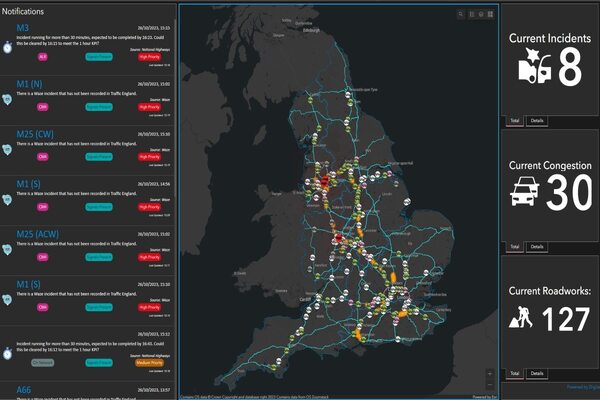
As well as creating a single digital model of the Strategic Road Network (SRN), control rooms across the country are now using a Single View of the Network (SVN) dashboard, which has incident alerts, details of roadworks, weather updates and the location of traffic officers available on an interactive map.
Spatial data in the SRN model includes information on over 4,000 miles of highway, bridges, tunnels and other assets including road signs and cameras.
“Our vision for the digital roads of the future will incorporate new capabilities, such as digital twins, predictive planning, single view of assets, and connected autonomous vehicles”
Benefits to date include being able to predict problem locations and deploying traffic officers more quickly, better coordination of roadworks to reduce disruption and optimising traffic flows to reduce congestion and emissions.
It also removes the need to maintain multiple road models within multiple systems and, through these efficiencies, National Highways has decreased its total cost of GIS ownership by more than 10 per cent compared to two years ago.
Read More
National Highways has also been announced as the only UK winner of an Esri Special Achievement in GIS Award. The award was made at the Esri annual User Conference in California, one of the world’s largest geospatial industry events, attracting almost 40,000 attendees.
Special Achievement in GIS Awards recognise organisations which are demonstrating geospatial leadership in their field and setting new precedents for the global GIS community. More than 100,000 entries were submitted worldwide.
“This award is a significant achievement for our team,” said National Highways chief data officer, Davin Crowley-Sweet. “Our spatial data is the ‘crown jewels’ of our data landscape – the primary key of primary keys. Having a single view of it to support the whole organisation helps foster a data-driven culture, increasing business benefits and critical for delivering our Digital Roads vision and beyond.
“We are always looking for new ways to make people’s journeys smoother and safer on our roads and we are now able to react more swiftly to incidents to get traffic moving again as quickly as possible.
“Meanwhile, our vision for the digital roads of the future will incorporate new capabilities, such as digital twins, predictive planning, single view of assets, and connected autonomous vehicles. Each of these initiatives will require a common, trusted representation of the network to be successful.”
“Our spatial data is the ‘crown jewels’ of our data landscape. Having a single view of it to support the whole organisation helps foster a data-driven culture”
National Highways made the move to an Esri enterprise GIS over a year ago, following recognition that geospatial data was its most critical type of data – the result of an in-depth asset evaluation which valued its data overall at £60bn. Delivered via Esri UK’s Managed Cloud Service, the GIS consolidates all location data into one central system and provides a wide range of applications, data models and other GIS services, enabling 5,660 staff to make better use of spatial data.
“National Highways is at the forefront of demonstrating what a true enterprise GIS can achieve,” said Chris Barber, head of transport at Esri UK. “Esri technology is helping to maximise the value gained from geospatial data which is now used more extensively across the organisation. Taking an enterprise approach gives National Highways a solid, scalable foundation to help meet its Digital Roads objectives and tackle some of the most pressing challenges facing our roads today and in years to come.”
National Highways has set out its Digital Road 2025 vision detailing how the growth of digital technology and the move to electric, connected and autonomous vehicles will fundamentally change how roads are designed, built, operated and used by drivers.
Why not try these links to see what our SmartCitiesWorld AI can tell you.
(Please note this is an experimental service)
How does the Single View of the Network improve incident response times?What role does Esri GIS play in reducing National Highways' operational costs?How can digital twins enhance predictive planning for road maintenance?In what ways does consolidated geospatial data optimize traffic flow management?How will connected autonomous vehicles integrate with the Digital Roads strategy?
Latest City Profile
Latest Urban Exchange Podcast
Latest Special Report
SmartCitiesWorld Newsletters (Daily/Weekly)
You may also like these related articles...
BECOME A MEMBER
© 2026 SmartCitiesWorld
Smart Cities World Ltd, 37 Lombard Street, London, EC3V 9BQ