











 22 - 26 June 2026: Find out more






BUILD YOUR OWN
RESOURCE LIBRARY



Podcasts

Cities Thriving on Lighting, Episode 2 – Simplicity by design in smart lightingSponsored by Paradox Engineering
Cities Thriving on Lighting, Episode 1 – Lighting as the backbone of the smart citySponsored by Paradox Engineering
Opinions

Transforming indoor public safety with smart sensor networksSponsored by Motorola Solutions
Dutch cities team to optimise shared mobility
The cities are seeking to understand how new sustainable modes of travel can be developed in complementarity with existing public transport offers.


The Dutch cities of Amsterdam, Utrecht and Eindhoven have selected mobility data platform Vianova to help optimise the integration of shared mobility services.
Through this partnership, the European startup is helping the three cities improve their collaboration with mobility operators through data insights.
Sustainable mobility
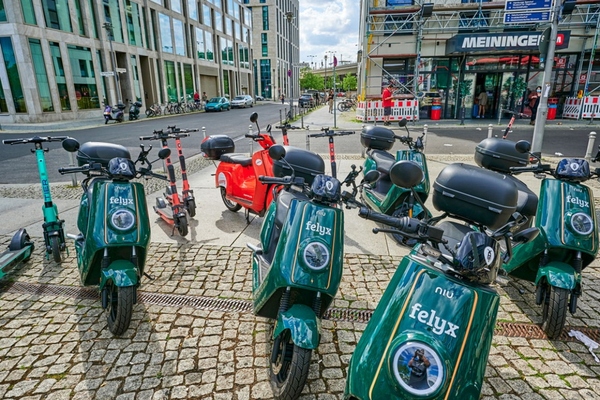
The Netherlands is ranked as one of the most advanced countries in terms of sustainable mobility. In a country where more than half of the inhabitants declare they ride a bike at least twice a week, the development of new shared mobility offers a significant potential to further decarbonise cities’ transportation systems.
With a reported more than 5,000 shared mobility devices in the capital city alone, and numerous infrastructures dedicated to active mobility in the country, the Netherlands is recognised as a pioneer country for carbon neutral transport.
Partnering with mobility data platform Vianova, the cities are seeking to understand how new sustainable modes of travel can be developed in complementarity with existing public transport offers. According to the cities, this challenge cannot be met without having a thorough understanding of the mobility data which is crucial to implement public policies that guarantee the efficiency and safety of the transport system.
The cities want to define the best policies and urban planning for new mobility services through actionable data insights
Amsterdam, Utrecht and Eindhoven have partnered with Vianova to help bridge the communication gap between public authorities and mobility operators. The cities want to define the best policies and urban planning for new mobility services through actionable data insights.
These insights are derived from mobility data feeds that Dutch cities can easily retrieve from Vianova’s Data Exchange, where data providers can accept or decline different data requests, and visualise the use cases for this data.
Vianova reports all mobility providers in the Netherlands are already sharing their data with cities through this marketplace, and more transport practitioners are joining the marketplace on a continuous basis, adding feeds from various industry segments, including automotive manufacturers and charge point operators (CPO).
This will keep unlocking more use cases beyond shared micro-mobility management, for instance, road safety intelligence, kerb space management or infrastructure planning.
Read More
Since early 2022, Vianova has been helping the three cities achieve various use cases, including:
- monitoring moped flows into and out of Amsterdam’s adjacent cities: trips starting or ending outside of Amsterdam are one of the most popular uses of mopeds in the city, accounting for six of the 12 most popular origin and destination pairings. The City uses the Vianova platform to identify these trends and understand the impact on the overall fleet size within the city as a result of these inflows and outflows
- designing parking policies to improve public order in Utrecht: communication between the City and its mobility provider, Tier, is critical to the success of the shared mobility programme. Utrecht uses Vianova’s tools to publish information about the location of approved parking zones for bicycles and mopeds, and to notify Tier when devices are parked out-of-bounds in order to minimise citizens’ complaints
- taking a multimodal approach to shared mobility in Eindhoven: with both bicycles and mopeds from different providers, Eindhoven uses the Vianova platform to understand the comparative impact between mode types. Evaluating metrics such as trip distance, duration, and frequency, the City is able to develop a better understanding of how the two micromobility modes serve different niches in the region’s transportation ecosystem.
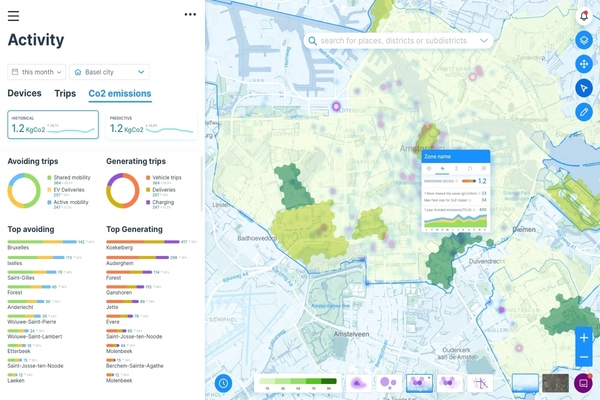
The City of Amsterdam is also among the first users of Vianova’s new CO2 emissions monitoring and reduction tool. This new AI-powered feature facilitates the dynamic distribution of shared fleets across multiple modes.
All mobility providers in the Netherlands are already sharing their data with cities through this marketplace, and more transport practitioners are joining the marketplace on a continuous basis
According to the startup, it enables cities to identify policies that would help achieve the highest CO2 reduction when balanced against other priorities of the city. Vianova claims the tool represents a huge potential for both transport providers and cities to design the most efficient transportation system possible while curbing carbon emissions.
Moreover, the country’s largest cities are currently working on a national mobility data standard, the CDS-M format, which Vianova reports it is able to support in order for them to improve public authorities’ understanding and mobility policy management options.
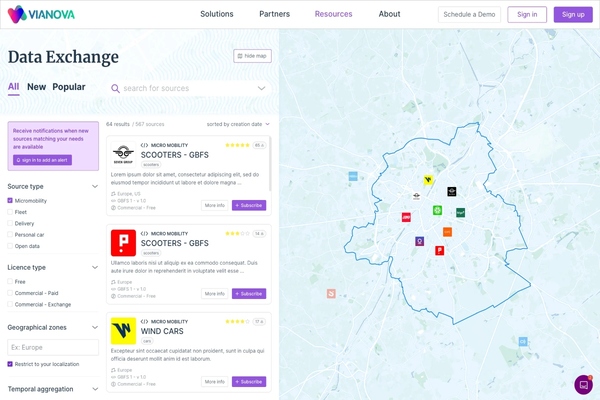
Mobility providers in the Netherlands are already sharing their data with cities through the marketplace
Why not try these links to see what our SmartCitiesWorld AI can tell you.
(Please note this is an experimental service)
How does Vianova's platform improve collaboration between cities and mobility operators?What data insights help optimize shared mobility alongside public transport?How can CO2 emissions monitoring influence shared mobility fleet distribution?In what ways does multimodal data support urban planning in Eindhoven?How does the CDS-M format enhance national mobility data standardization?air qualityAmsterdamclimate actioncongestionEindhovenelectric vehiclesEnergy & EnvironmentMicromobilitymobilityTransport hubsUtrechtVianova

Latest City Profile
Latest Urban Exchange Podcast
Latest Special Report
SmartCitiesWorld Newsletters (Daily/Weekly)
You may also like these related articles...
BECOME A MEMBER
© 2026 SmartCitiesWorld
Smart Cities World Ltd, 37 Lombard Street, London, EC3V 9BQ