
















BUILD YOUR OWN
RESOURCE LIBRARY



Podcasts

Cities Thriving on Lighting, Episode 2 – Simplicity by design in smart lightingSponsored by Paradox Engineering
Cities Thriving on Lighting, Episode 1 – Lighting as the backbone of the smart citySponsored by Paradox Engineering
Opinions

Transforming indoor public safety with smart sensor networksSponsored by Motorola Solutions
London ranked UK's greenest city
The high ratio of green spaces per 10,000 of the population, and availability of electric vehicle charging stations contributed to London’s leading position.



London's Blackfriars Bridge, which was equipped with solar panels in 2014
London has secured top spot in a leaderboard of the UK’s leading greenest cities.
Scores were calculated for UK cities based on four categories – nature, transport, emissions and sustainability. The research was commissioned by solar installer Project Solar UK.
Green spaces
London scored highest as investment in solar outshone the rest of the cities at £149,126 per million pounds of council budget. The high ratio of green spaces per 10,000 of the population, and availability of electric vehicle (EV) charging stations also contributed to its leading position.
Bristol was second, with the most EV charging points for drivers, at only 914 drivers per charger. In comparison, Birmingham EV drivers had 6,997 drivers per charging station. The high percentage of household recycling, and substantial investment in solar also made it a contender.
Manchester rounded out the top with a household recycling percentage of almost 39 per cent, and solar investment at £2,914 per million pounds of council budget.
The ‘nature’ scoring criteria comprised green spaces available, analysing parks per 10,000 of the population. The number of parks were taken from each local authority website.
Transport assessed EV charging provisions, analysing the number of EVs per charging point with the lower the figure representing the better the provision. The data was sourced from Uswitch.
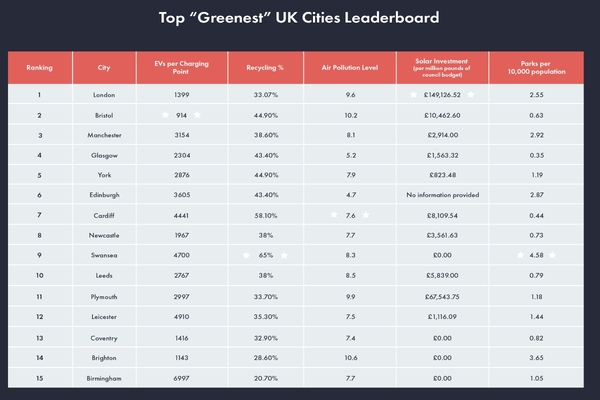
The ‘emissions’ criteria analysed levels of air pollution, with the lower the figure the lower the level of pollution. This data was sourced by IQAir.
“From planting trees and setting up communal composting areas to installing solar panels and purchasing electric vehicles, our communities are addressing environmental problems in their local areas”
Finally, the ‘sustainability’ criteria focused on investment into solar energy, judged by the investment per million pounds of council budget. Investment includes any expenditure on construction or maintenance of any new or existing solar energy projects.
All information for investment, energy produced, and number of PV fitted buildings was received by FOI request to city/borough councils carried out by thesolarcentre.
In addition to the four main criteria, attention was paid to household recycling efforts: the percentage of household waste sent for reuse, recycling, or composting for each city. This data was sourced from Waste Data Flow.
“While this research highlights that local authorities are working hard to fulfil their commitments around moving towards net zero, we also note that individuals and communities are taking critical steps towards carbon zero,” said Simon Peat, CEO of Project Solar UK.
“From planting trees and setting up communal composting areas to installing solar panels and purchasing electric vehicles, our communities are addressing environmental problems in their local areas. Together their proactive moves, such as choosing renewable energy sources and tackling waste, alongside those of local authorities, all help in addressing the climate emergency.”
Why not try these links to see what our SmartCitiesWorld AI can tell you.
(Please note this is an experimental service)
How does green space per capita impact urban sustainability rankings?What role do EV charging stations play in reducing city emissions?How is solar investment measured relative to council budgets?Which factors contribute most to improving household recycling rates?How do local authorities track and report solar energy projects?BristolCommunalCOP26Dataelectric vehicle chargingelectric vehiclesEnergyEnergy & EnvironmentFeaturedgreen spaceLondonManchesterParks and green spacePopulationProject Solar UKrecyclingRenewablessolar powerwaste
Latest City Profile
SmartCitiesWorld Newsletters (Daily/Weekly)
You may also like these related articles...
BECOME A MEMBER
© 2026 SmartCitiesWorld
Smart Cities World Ltd, 37 Lombard Street, London, EC3V 9BQ