


















BUILD YOUR OWN
RESOURCE LIBRARY



Opinions

Smart lighting: enabling smart cities beyond illuminationSponsored by Paradox Engineering

How AI and biometrics are shaping next-generation mobility paymentsSponsored by ST Engineering
Which cities will define the next economy?
The latest Global South City Competitiveness Index shows Global South cities are no longer catching up but reshaping the geography of global competitiveness.


 At a glance
Who: The SuperSymmetry Institute.
What: The Institute has released the Driving Urban Advantage in the Next Economy Report and the Global South City Competitiveness Index (GS-CCI 2025/2026). The headline finding in the latest index is the “near-elimination of the traditional North-South gap” at the top tier.
Why: The index aims to be a major benchmarking tool designed explicitly for cities in the Global South.
When: The index and report were released during the World Economic Forum Annual Meeting in Davos, Switzerland, which runs 19-23 January.
The SuperSymmetry Institute (SSI) has released the Driving Urban Advantage in the Next Economy Report and the Global South City Competitiveness Index (GS-CCI 2025/2026), the major benchmarking tool designed explicitly for cities in the Global South.
The Institute is an ecosystem of policy experts, visionaries, practitioners, pundits and academics who aim to bring their expertise to rebalance asymmetries between Global South and Global North. It released the report and index at the World Economic Forum Annual Meeting in Davos, Switzerland.
It reports the headline finding in the latest index as the “near-elimination of the traditional North-South gap” at the top tier.
Urban intelligence framework
The GS-CCI 2025/2026 introduces a multilayered urban intelligence framework that evaluates 48 global cities across three pillars – Urban Competitiveness, Business Environment, and Investment Attractiveness. Powered by 25 million datapoints and 257 indicators organised across 10 pillars and five economic hubs, GS-CCI 2025/2026 aims to move beyond outcome rankings to assess the institutional and economic capacity to act, the core of urban competitiveness in the Next Economy.
“Cities can no longer treat technology as an experiment or a side project,” said Dr Basma AlBuhairan, managing director of the WEF Affiliate Centre for the Fourth Industrial Revolution Centre in Saudi Arabia.
“It is central to how cities compete, grow, and serve their people. Those that combine technology with strong governance, coordinated planning, and capable institutions will define the Next Economy – where opportunity is inclusive, growth is sustainable, and cities lead with purpose.”
Five competitiveness tiers
The Index ranks cities into five competitiveness tiers: Leading, Advanced, Developing, Emerging, and Nascent. Leading cities demonstrate strong alignment between economic hubs, business environment, and governance capacity, enabling them to convert scale into productivity, resilience, and sustained advantage. Cities in lower tiers face deeper structural constraints, particularly in governance effectiveness, business conditions, and investment readiness.
“Cities can no longer treat technology as an experiment or a side project. It is central to how cities compete, grow, and serve their people”
As stated, the headline finding is the near-elimination of the traditional North-South gap at the top tier:
- Leading tier cities, including Singapore (1st), New York (2nd), London (3rd), Dubai (4th), and Beijing (5th), now perform on par with established global leaders. Dubai’s strength in Talent & Liveability, for instance, now surpasses all Global North peers, demonstrating how targeted investment can create world-leading liveability
- Cities in the Advanced through Nascent tiers show varying levels of alignment between ambition, enabling conditions, and delivery capacity, highlighting distinct developmental trajectories.
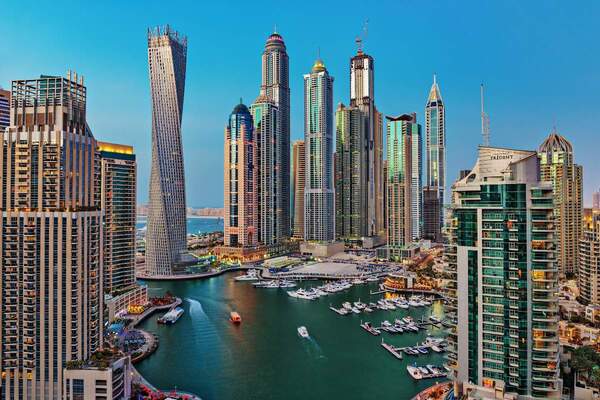
Dubai’s strength in Talent & Liveability now surpasses all Global North peers, demonstrating how targeted investment can create world-leading liveability
“Global South cities are no longer catching up. They are actively reshaping the geography of global competitiveness,” said Alexey Prazdnichnykh, project lead.
“Location still matters, but governance increasingly determines whether cities succeed or fall behind.”
Regional patterns
The Symmetry Institute reports that competitiveness across the Global South is marked by significant regional variation and internal disparities:
- East Asia leads with the highest median score (59.9), driven by scale, innovation ecosystems, and infrastructure. Beijing’s leadership in the Technology Development & Innovation pillar exemplifies this, with a score rivalling Silicon Valley
- Middle East and North Africa (Mena) (50.1) shows how strategic investment and governance reform can propel cities forward. Abu Dhabi and Riyadh have leveraged sovereign investment and clear strategy to jump into the advanced and leading tiers
- South Asia and Southeast Asia cluster near the global median (48.1 and 46.7), with wide internal gaps. Bengaluru (Advanced tier) thrives as a deep-tech hub, while others in the region face infrastructure constraints
- Latin America, Sub-Saharan Africa, and Eurasia record lower median scores (42.6, 42.1, and 40.4, respectively), reflecting persistent challenges. Yet, Cape Town’s strong creative cluster and Santiago’s relative stability show pathways to regional leadership
- North America remains the global benchmark for urban competitiveness, with leadership in innovation, finance, and city performance. Records the highest median GS-CCI score (~64) among all regions in the Index. Both cities included New York and Toronto rank in the Leading Tier, reflecting consistently strong economic foundations, institutional quality, and infrastructure maturity.
When it comes to international cooperation, Anastasia Kalinina, founding steward at SSI, said it requires “a shared, data-driven understanding of global asymmetries”. “At the SSI, as an ecosystem of policy experts, visionaries, and business leads, we believe that open dialogue all over the globe is the cornerstone of equitable progress.
“Location still matters, but governance increasingly determines whether cities succeed or fall behind”
“This report is considered as a tool for action. By showing the gaps between the Global South and North, we aim to rebalance the scales of opportunity and foster a new era of genuine international cooperation.”
The report reframes international cooperation as a practical competitiveness lever. It highlights that success comes from moving beyond symbolic partnerships to focused action. Nairobi’s role in the LAPSSET corridor embeds it in regional trade flows; Cape Town’s film industry leverages global airline partnerships and co-production treaties, and the Vietnam-Singapore Industrial Parks (VSIP) model has transferred world-class zone management and investor services to Ho Chi Minh City and Hanoi.
Governance and delivery
The Index establishes “future-proof governance” as the foundation that turns ambition into results. It is the “decisive differentiator” between cities that strategise and those that deliver sustained competitiveness. The Institute adds that effective governance is characterised by a city’s ability to set a clear long-term vision, coordinate action across fragmented institutions, ensure financial sustainability, and engage business as a core partner in execution.
The report highlights that cities with strong governance mechanisms, like Singapore’s integrated network of specialised agencies or Dubai’s programme-based budgeting that ties the D33 economic agenda directly to funding and key performance indicators, demonstrate how institutional capacity translates strategy into on-the-ground outcomes.
“By showing the gaps between the Global South and North, we aim to rebalance the scales of opportunity and foster a new era of genuine international cooperation”
The Index also reveals that even cities with abundant resources or strategic advantages can be held back by fragmented, reactive, or opaque governance. This gap between planning and implementation is a primary constraint for cities in lower tiers. The report concludes that without this foundational governance capacity, efforts to improve business environments or develop economic hubs are likely to be unsustainable.
The GS-CCI 2025/2026 is designed as a strategic dialogue tool, that helps cities diagnose their unique structural strengths and binding constraints, prioritise interventions, and design evidence-based roadmaps for transformation.
About the Global South City Competitiveness Index (GS-CCI 2025/2026)
Scope: 48 global cities with a principal focus on the Global South across three core dimensions that shape long-term competitiveness: Economic & Enabling Environment, Infrastructure & Systems, and Talent & Liveability.
Architecture: 257 indicators, 10 pillars and 50 sub-pillars, allowing for a detailed and comparable assessment of urban strengths and constraints, and five economic hubs – cluster strength, business dynamism, innovation capacity, investment readiness, and global connectivity.
Methodology: 25 million datapoints combining big data with traditional and new economy metrics to capture foundational capabilities, not just outcomes.
Why not try these links to see what our SmartCitiesWorld AI can tell you.
(Please note this is an experimental service)
How does strong governance enhance urban competitiveness in Global South cities?What role does technology integration play in defining the Next Economy?How can cities leverage investment attractiveness to boost economic growth?Which governance practices enable effective coordination across fragmented institutions?How do regional innovation ecosystems impact city competitiveness scores?demographic changeeconomic developmentGovernance and CitizeninclusivityPeople and SkillsPolicy Making
Latest City Profile
SmartCitiesWorld Newsletters (Daily/Weekly)
You may also like these related articles...
BECOME A MEMBER
© 2026 SmartCitiesWorld
Smart Cities World Ltd, 27 Clements Lane, London, EC4N 7AE