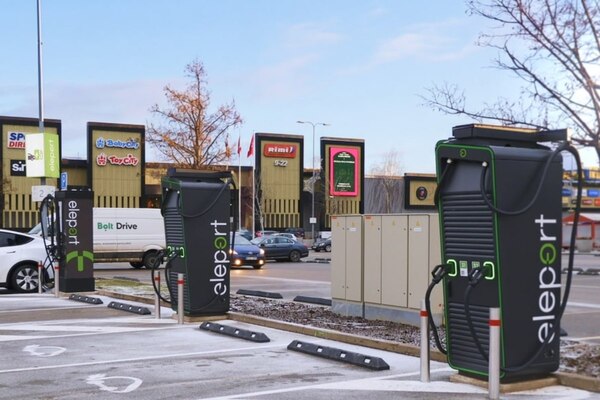








Following the loan, network operator Eleport will deploy more than 250 fast-charging hubs at shopping and commercial centres across Central and Eastern Europe.
At a glance
Who: European Investment Bank (EIB); Eleport.
What: Following a €35m loan from EIB, network operator Eleport will deploy more than 250 fast-charging hubs at major shopping and commercial centres in Croatia, Czechia, Estonia, Latvia, Lithuania, Poland, Slovakia and Slovenia.
Why: The EIB loan advances European Union goals to cut car pollution and promote regional development. Scaling up fast‑charging infrastructure is essential to accelerate the shift to electric mobility and reduce emissions from road transport.
Where: Eleport plans to complete the project by 2028.
Central and Eastern European countries will gain hundreds of new electric-vehicle (EV) charging stations following a €35m loan that network operator Eleport is receiving from the European Investment Bank (EIB).
Eleport is a rapidly expanding startup based in the Estonian capital Tallinn and is already active in Central and Eastern Europe.
Eleport will use the EIB credit to deploy more than 250 fast-charging hubs at major shopping and commercial centres in Croatia, Czechia, Estonia, Latvia, Lithuania, Poland, Slovakia and Slovenia. It plans to complete the project by 2028.
Each station will feature as many as 12 charging plugs with power of up to 400 kilowatts (kW) per plug, enabling drivers to charge quickly while they go about their everyday activities.
“Scaling up fast‑charging infrastructure is essential to accelerate the shift to electric mobility and reduce emissions from road transport”
The EIB loan advances European Union goals to cut car pollution and promote regional development. Tailor-made financing structures allow the EIB to support promising companies early in their growth journey by taking on higher credit risk thanks to backing from the InvestEU programme.
“Scaling up fast‑charging infrastructure is essential to accelerate the shift to electric mobility and reduce emissions from road transport,” said EIB vice-president Karl Nehammer.
“This operation demonstrates how we can provide innovative, long‑term financing to fast‑growing companies delivering high‑impact sustainable infrastructure.”
Eleport already operates more than 400 fast charging points (DCs) in six countries – Estonia, Latvia, Lithuania, Poland, Slovenia, and Croatia and is building an “Electric Amber Road” – a network inspired by the ancient trade routes known as the Amber Road that connected the Baltic and Adriatic coasts. The project will allow cross-border drivers to use a single app for fast charging along the whole network.
“This EIB loan is an important step in expanding reliable, high-quality charging infrastructure across Central and Eastern Europe,” said Eleport chief executive officer Jakub Miler. “Our goal is for electric-vehicle drivers to be able to stop where they already need to be, plug in briefly and move on with their day.”
The project is fully aligned with EU climate goals, classified by the EIB as 100 per cent climate action and environmental sustainability.
The EIB loan agreement is backed by the InvestEU programme, which aims to trigger more than €372bn in additional investment between 2021 and 2027. The InvestEU programme mobilises investment for EU policy priorities like the green transition, competitiveness, innovation and sustainable infrastructure.
The InvestEU programme provides the European Union with crucial long-term funding by leveraging substantial private and public funds in support of a sustainable recovery. It also helps mobilise private investments for the European Union’s policy priorities, such as the European Green Deal and the digital transition.
Why not try these links to see what our SmartCitiesWorld AI can tell you.
(Please note this is an experimental service)
How will Eleport's fast-charging hubs impact EV adoption in Central Europe?What role does the EIB loan play in accelerating electric mobility infrastructure?How does the Electric Amber Road improve cross-border EV charging convenience?In what ways does InvestEU support sustainable infrastructure investments?How do 400 kW charging plugs enhance the efficiency of EV charging stations?