







Port will use the boat for its work on the Exe Estuary and collaborate with Exeter University’s Centre for Future Clean Mobility to gather data from the vessel.
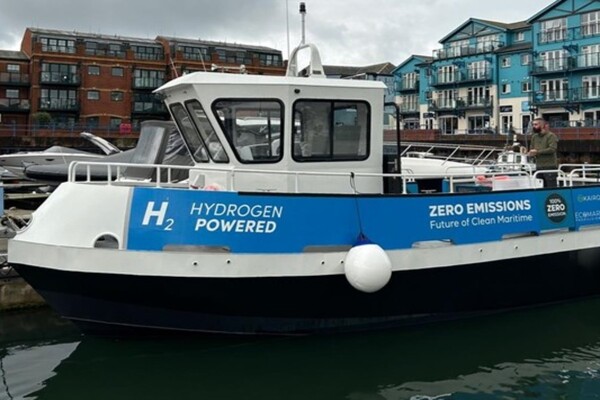
The Exeter Port Authority in the UK has taken delivery of a new hydrogen electric boat for a trial period for its work on the Exe Estuary.
Working alongside the Port and the boat designer Ecomar propulsion, Exeter University’s Centre for Future Clean Mobility will be gathering data from the vessel as it enters an extended period of trials over the next few months.
The boat has been made and designed by Ecomar Propulsion and will be based on the estuary for a limited period of time to assist with the trials and testing of the vessel.
The boat was launched into Exmouth harbour and is currently in the final stages of fitting out. A team from Ecomar Propulsion is currently installing the last items on an innovative new power system.
“We hope to be able to prove to the communities around the River Exe that the transition to clean maritime is easy and safe and above all sensible”
MV Dirac is based on a NATO Combat Ready Boat but has been radically redesigned internally. It is powered by two 250kW Ecomar Kairos motors and holds 180kWh of Li Ion Batteries which are supplemented by a hydrogen fuel cell that extends the range of the vessel considerably. The hydrogen is supplied in hand-portable BOC Genie bottles which are easily replaced and stored onboard. This means that it is possible to recharge the vessel whenever and wherever necessary.
The boat is named after one of the UK’s greatest scientific minds, Paul Dirac, who won a Nobel prize for his work in quantum physics.
“The beauty of the hydrogen refuelling is that the port doesn’t need to install expensive equipment. We can carry the bottles to the boat and they weigh about the same as a regular barbeque bottle. We can easily charge the batteries directly from the pontoon as well, so it makes the move to clean energy really easy,” said Grahame Forshaw, Exeter Port Authority’s harbour master.
“We hope to be able to prove to the communities around the River Exe that the transition to clean maritime is easy and safe and above all sensible,” said Ecomar Propulsion CEO, Eugene Bari. “We understand that people have reservations about range and safety but the reality is very different from perception and we hope to be able to demonstrate that with the cooperation of forward thinking ports like Exeter, Britain can lead the world in decarbonising our waterways.”
Over the next few months, the Ecomar team will continue to upgrade and modify the systems as it enters regular service with the Port.
Professor Chris Smith form the Centre for Future Clean Mobility. added: “We have worked with the Ecomar team for a number of years in projects funded by the government’s Clean Maritime Demonstrator Call, and helped them get their ground-breaking hydrogen-battery hybrid propulsion system designed and working. So we’re delighted to see the fruits of all this hard work which is the boat Dirac. We will be taking data from her on the River Exe which will help us improve propulsion systems in other new clean boats.”
Once Dirac is fully commissioned it will be seen all along the River Exe and the team from the Port and Ecomar are keen to explain how it all works. “Ecomar aim to set up a series of discussion sessions around the River Exe over the next few months. Change requires a two-way dialogue, we want to provide answers where we can and also to see what we can learn to make things better for everyone,” added Bari.
Councillor Ruth Williams, Exeter City Council’s lead councillor city management, said: “We’re delighted to be trialling this boat and using green technology on the Exe Estuary. It’s great to be working closely with the University on ground-breaking initiatives like this and it certainly is a step in the right direction as we move towards becoming zero carbon by 2030.”
Why not try these links to see what our SmartCitiesWorld AI can tell you.
(Please note this is an experimental service)
How does the hydrogen fuel cell extend the boat's operational range?What are the safety benefits of using portable hydrogen fuel bottles?How will data from the boat improve future clean maritime propulsion?In what ways does the hybrid system reduce carbon emissions on waterways?How can ports implement this technology without expensive refuelling infrastructure?