








BUILD YOUR OWN
RESOURCE LIBRARY



Podcasts
Cities Thriving on Lighting, Episode 2 – Simplicity by design in smart lightingSponsored by Paradox Engineering
Cities Thriving on Lighting, Episode 1 – Lighting as the backbone of the smart citySponsored by Paradox Engineering
University trials driverless shuttle
Researchers at the University of South Florida have begun an autonomous trial with Coast Autonomous to transport students, faculty staff and visitors in a driverless vehicle


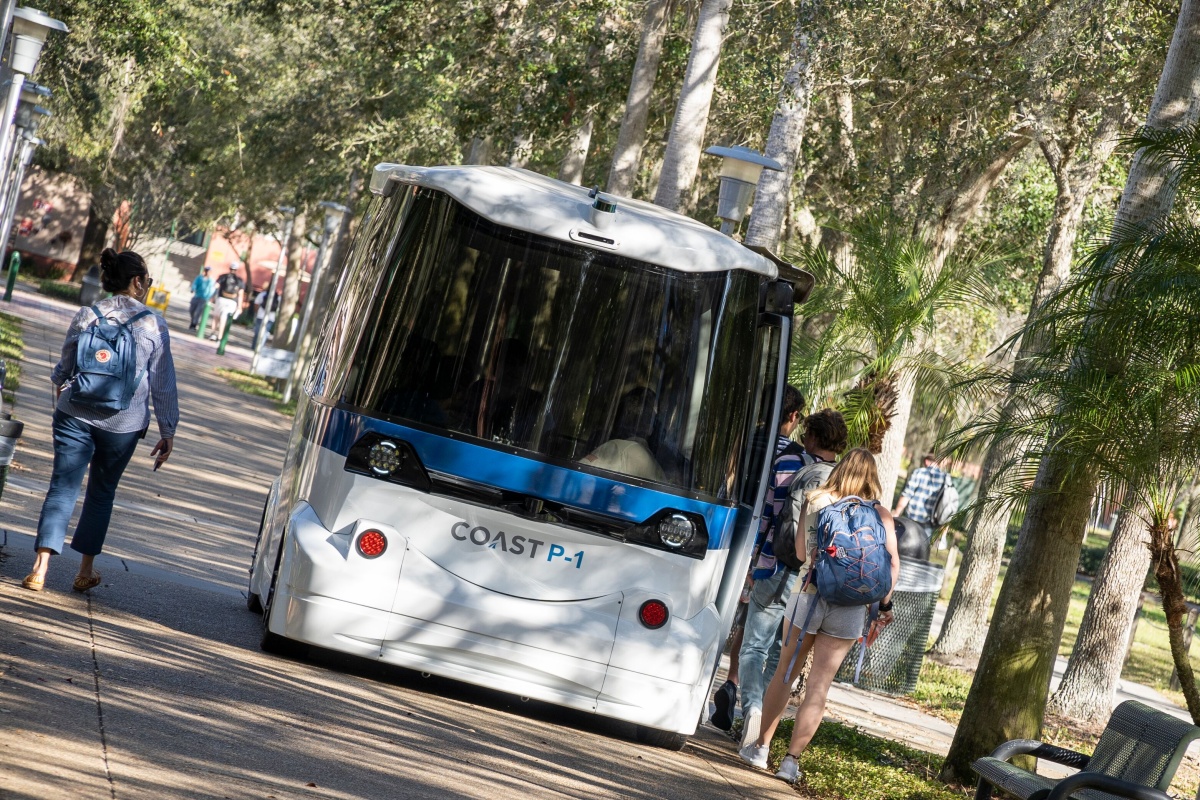
Shuttle drives itself along a walkway between the library and campus recreation centre
Researchers at the University of South Florida (USF) are hosting an autonomous vehicle demonstration featuring a self-drivng shuttle along a busy central walkway, in partnership with Coast Autonomous.
The aim of the vehicle trial featuring a Coast P-1 shuttle is to explore attitudes toward new modes of campus transportation. The university considers it important to use the campus environment as a testbed for future multimodal, sustainable transportation technology, including connected and automated vehicles.
First- and last-mile transportation
The shuttle is being demonstrated on the USF Tampa campus and is providing USF students, faculty, staff and visitors with a free, driverless ride. The shuttle is driving itself along the walkway between the library and the campus recreation centre.
Led by the Centre for Urban Transportation Research (CUTR) at USF, this trial is the first of its kind on campus, leveraging a low-speed autonomous vehicle that is ideal for first- and last-mile transportation and can help increase pedestrianism and reduce CO2 emissions.
The trial will last for one week, giving researchers the opportunity to gauge people’s reactions and attitudes towards these vehicles and showcasing how driverless vehicles can interact with pedestrians, bicyclists and skateboarders in a very busy campus environment.
“The future of urban mobility will be electric, shared and a mix of modes including autonomous vehicles,” said Dr Pei-Sung Lin of the Centre for Urban Transportation Research. “We believe that new modes such as self-driving shuttles will form a key part of the next generation of urban transportation.
“Seamless integration between existing and new modes of transportation will likely make for better urban environments. It is great to be able to work with Coast to showcase an autonomous shuttle working in such a busy environment and we are very excited to see how our students react to new forms of transportation.”
“The future of urban mobility will be electric, shared and a mix of modes including autonomous vehicles”
The Coast P-1 shuttle is a bi-directional, self-driving vehicle that is designed to operate in pedestrian areas or in mixed traffic (up to 25mph). The P-1 shuttle can travel at higher speeds on a dedicated lane. Electric wheel hub motors provide a smooth ride and allow for a larger floor plan within the vehicle because there are no axles.
Also configured as a delivery vehicle
The shuttle comfortably accommodates eight seated and four standing, but with fewer seats could carry up to 20 passengers. Additionally, the P-1 chassis can be configured as a delivery vehicle.
The vehicle is completely driverless and has no pedals or steering wheel.
It can operate on a network of pre-defined routes or be called on demand via a smartphone app, in which case the best route would be determined by Coast’s mapping software.
“It is proving to be a great demonstration and I am very happy with the way the P-1 shuttle is operating in this complex environment with so many pedestrians, bicyclists and skateboarders,” added Pierre Lefevre, Coast CTO and inventor of the first low-speed autonomous shuttle.
“Our technology will also work in mixed traffic and on segregated lanes which will all form part of a seamless transportation experience that can increase walkability and improve urban and campus life.”
You might also like:
Why not try these links to see what our SmartCitiesWorld AI can tell you.
(Please note this is an experimental service)
How does the Coast P-1 shuttle improve first- and last-mile transportation?What safety features enable the shuttle to operate among pedestrians and cyclists?How can autonomous shuttles reduce campus CO2 emissions effectively?In what ways does the shuttle's electric wheel hub motor enhance ride quality?How does the shuttle's on-demand routing system optimize passenger transport?autonomouscampusCentre for Urban Transportation ResearchCoast AutonomousCUTRDr Pei-SungdriverlessFeaturedP-1 ShuttlePierre LefevreRoadTransportUniversity of South Floridaurban mobility
Latest City Profile
SmartCitiesWorld Newsletters (Daily/Weekly)
You may also like these related articles...
BECOME A MEMBER
© 2026 SmartCitiesWorld
Smart Cities World Ltd, 37 Lombard Street, London, EC3V 9BQ