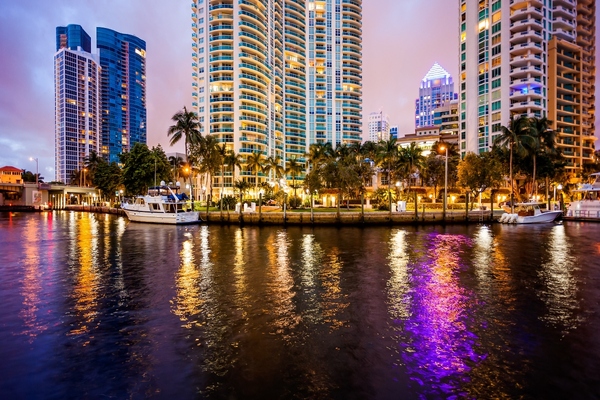






Sarah Hannah-Spurlock, night-time economy manager, City of Fort Lauderdale, Florida, believes cities have to break out of the nine to five mindset if they are to build night-time economies that work for citizens and visitors.
SmartCitiesWorld: What is your role and how did it come about?
Sarah Hannah-Spurlock (SHS): The position as night-time economy manager was created about five years ago after the City of Fort Lauderdale hired a consultant from the Responsible Hospitality Institute to conduct a study of the city’s sociable nightlife and public safety environment. They talked to lots of stakeholders in the community about what they were looking for, what exists, what would be the ideal situation for them, and how we could get there.
Out of that came a recommendation to create my role. Initially, it was more oriented towards compliance and regulation. I had a team of 10 people, including police officers, people from the fire marshal’s office and sanitation workers and our role was to keep a lid on things.
My team and I set up a hotline and we developed good relationships and partnerships with the venues and their operators. We wanted to be more like partners and help them out to comply with laws and rules. And I was of the belief that we should make our nightlife more vibrant and not just lay the hammer down. So we had a really good thing going and our sanitation crews kept the streets clean late at night.
"I was an advocate for businesses during the pandemic because, as we all know, the hospitality industry was hit the hardest"
But then, about a year into the job, there were some budgetary concerns in the city and the team was cut. We went from 10 people to one and that shifted my focus – I couldn’t be enforcement any more so I shifted to advocacy. Mostly, I have really good relationships in the community and feel like I’m a good liaison with the hospitality and nightlife industries. I’ve been able to fill that role and help them navigate the bureaucracy, so to speak. I’ve been in local government for over 20 years so I know who to call and who to talk to, but I’ve also worked in the hospitality industry, having bartended and waited tables to get through school, so I have a special place in my heart for the industry.
We’ve been able to streamline some processes for our businesses and I was an advocate for them during the pandemic, because as we all know, the hospitality industry was hit the hardest. I was there to make sure they had a seat at the table. So we’ve made some good progress and we’re working on a number of things

SCW: Has the emphasis and agenda now fully shifted from cleanliness and safety to vibrancy and revitalisation?
SHS: Yes, in my mind. People might say, “we’re Fort Lauderdale, we have the beach, we have the sun, why do we need to do anything? People want to be here.” But there’s more to making your nightlife vibrant than the beach and the sun, and it’s about more than just entertainment, bars and nightclubs. It’s also transportation and good environmental design and planning to make the streets safe for pedestrians and for cyclists. It’s also about making sure that female bartender who closes the bar and gets off home at 5am can walk to the car or get to public transport safely and conveniently.
"I believe every city needs a night-time manager because we live in a 24-hour world"
The buses stop running around midnight, which doesn’t help the people that work after midnight. So there’s lots of things that we want to accomplish. It’s just getting that that buy-in and support and those champions.
SCW: How do you manage to combine all of these different strands and still keep vibrancy front of mind?
SHS: I’ve taken a grassroots approach. I talk to a lot of people in the community and any business association that will listen to me. Obviously, I talk to the hospitality industry a lot. The city is now a member of the Florida Restaurant & Lodging Association, which is a first. I want to show them what my office is trying to accomplish and communicate – that we’re here as a good partner and want to help and build that momentum. It’s about finding champions and finding folks in the community the that are willing to help the cause.
SCW: Does it sometimes feel challenging working with other departments internally, like transport, for example, to get things done?
SHS: Absolutely, but fortunately, like I said, I’ve been doing this a long time so I’m used to collaborating and partnering with departments. So yes, that is a challenge, but it’s a challenge I’ve always experienced in every position I’ve been in so I’m comfortable doing it.
SCW: Have you also teamed up with the local Chamber of Commerce and Board of Trades?
SHS: Yes, I have a great relationship with the Chamber and the Greater Fort Lauderdale Alliance, which is the economic development engine of Broward County. We have lots of business alliances within the community that I have very good relationships with them. They all appreciate the fact that the city has taken a lead in looking at this so I get a lot of support from them. It’s a case of leveraging that support and turning it into action by the city because that’s where the laws are passed and referrals are made.
SCW: What about other cities -- do you share ideas and concepts?
SHS: Yes, there are now 12 to 15 of us in the country and I believe every city needs a night-time manager because we live in a 24-hour world. Those amenities and service provisions at night are very important if you want to create a global marketplace and be relevant to the worldwide community. You need to have a decent nightlife and a safe one. As I said, it’s not just about bars and restaurants; if I work during the day and need to go to the dentist, an 8pm appointment would be great, or a haircut at 9pm. It’s a case of trying to change that mindset that we have to operate on a nine to five basis all of the time. In fact, it might be better for traffic and lots of infrastructure, such as utility usage, if we did spread things out more.
These are the things I talk about and advocate for and hope some will stick. I’m also one of the founding members of the professional association that we formed around a year ago called Nitecap (Nighttime Economy Culture and Policy Alliance) and we hope to recruit more and more night-time managers to this.
SCW: Do you think those cities who haven’t appointed someone in a similar role yet are having the same conversations as Fort Lauderdale did at the outset of the process?
SHS: Other cities are definitely having conversations on their elected bodies about late night revelry and chaos. The reaction to bad behaviour and chaos is to shut it down but there are so many other ways to deal with it. That’s what we like to promote: your late night activity doesn’t have to be bad. For example, closing time is a huge issue and whether it’s midnight, 2am or 4am, trouble usually happens when everybody is leaving.
"The more varied and diverse you can make that night-time activity, the more you create a natural safety"
But if you look at New Orleans, for example, it never closes so they never have the closing time chaos. I’m not suggesting every city stays open 24 hours but there’s a lesson to be learned there and there are ways to manage late-night activity.
SCW: What else can make our cities attractive at night? People think bars and restaurants but what about museums as an example?
SHS: Yes, a lot of museums close at 5pm but why not keep them open? I’m also a big advocate of keeping libraries open. The more varied and diverse you can make that night-time activity, the more you create a natural safety. So you’ve got people of all demographics that are staying around to enjoy the city. You’re not just switching the light from daytime crowds to this late-night drinking thing. Creating a mix has a natural calming effect.
Also, here in the south-west, it’s brutally hot in the summer time and a lot of the parks close at dusk. Keeping the parks open for some late-night activation would also help address a range of different issues. Activation creates a natural organic safety. Law enforcement can only go so far and a deserted street or park is a lot more dangerous than an activated street or park. I’ve walked around New York City by myself late at night felt perfectly comfortable because there’s activity and people around.

SCW: Do you think staffing is one of the challenges preventing more night-time openings?
SHS: Yes, but it creates more employment opportunity. I realise in our labour shortage right now it may not be doable but somebody’s got to start somewhere. One of our primary museums, the Nova Southeastern University Museum downtown, opens one night a month and it would just be great if more did that.
We just need to look at the service provision that cities provide, and ask “what’s the night-time lens perspective of this issue” – whether it’s transportation and mobility or the water supply – as night-time is just as relevant. Night-time should be a good time.
It’s also when culture and creativity are nurtured – typically, creative artists do their best work at night. So the city should be doing what it can to encourage that and support them. Affordable housing, as in many places, is an issue in Fort Lauderdale. We want those artists and those creative energies to be in our city to create that nightlife destination, but they can’t afford to live there. Cheap transportation is another issue. These are things that we need to be addressing and what I try to advocate for.
SCW: What do you consider your top two or three successes in the last few years?
SHS: One of them is probably more subjective in that the hospitality business community now has somebody speaking on their behalf and advocating for them on the city level, and they’re not accustomed to that. The Chamber does its part, but the Chamber is not the city, the Chamber is not the one making the rules and the policy or passing laws. So having somebody on the city staff to say, “it would be great if we could do something about parking to help outdoor dining”, for instance, is great. Just creating that relationship has really been a major success.
"The hospitality business community now has somebody speaking on their behalf and advocating for them on the city level"
We’ve also streamlined some of the processes in areas like special event planning on the beach – making it easier for the hotels to have events on the beach without going through all the rigour of commission approval and that sort of thing. We supported them during the pandemic to make outdoor dining more accessible and available. Right now I’m working on an ordinance to allow hotels to serve food and beverage on the beach, including alcohol, which would be really unprecedented on a public beach.
It’s efforts like these that recognise that these businesses have something to contribute to the character and uniqueness of the community.
Why not try these links to see what our SmartCitiesWorld AI can tell you.
(Please note this is an experimental service)
How can cities effectively integrate night-time economy managers into governance structures?What strategies improve safety and accessibility for late-night public transportation?How does diverse night-time activity contribute to natural safety in urban areas?What policy changes support hospitality businesses during economic challenges like pandemics?How can cities balance regulation and vibrancy in developing their night-time economies?