

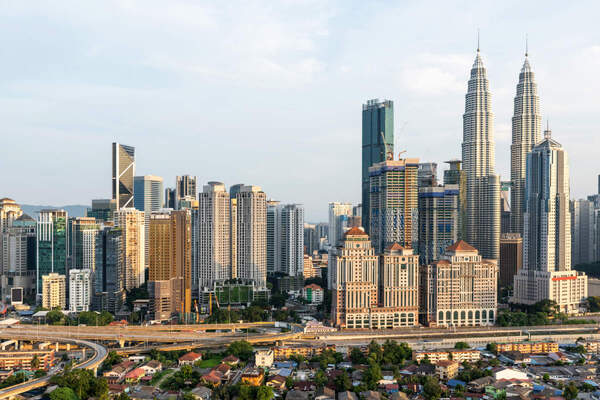

Malaysian capital worked with C40 Cities and the UK on a four-year initiative to integrate inclusive, practical climate action into planning and operations.
At a glance
Who: Kuala Lumpur City Hall (DBKL); C40 Cities; British High Commission.
What: The Malaysian capital has held a ceremony to officially mark the handing over of C40’s UK-funded Urban Climate Action Programme (UCAP) Climate Action Implementation (CAI) portfolio.
Why: The resulting blueprint will serve as the city’s practical and inclusive roadmap for decarbonising its built environment, outlining specific targets and milestones.
When: The decarbonising roadmap runs until 2050.
Malaysian capital Kuala Lumpur has held a ceremony to officially mark the handing over of C40’s UK-funded Urban Climate Action Programme (UCAP) Climate Action Implementation (CAI) portfolio.
The four-year initiative has seen the integration of inclusive and practical climate action into the city’s planning and operations.
The centerpiece of the ceremony was the official launch of the Kuala Lumpur Net Zero Carbon Building (NZCB) Roadmap 2050. It serves as the city’s blueprint for decarbonising its built environment, outlining specific targets and milestones to achieve a 70 per cent reduction in carbon emissions intensity by 2030.
Distinctively, the roadmap is among the first of its kind in Kuala Lumpur City Hall (DBKL) to feature a multi-stakeholder governance structure, integrating external agencies and private sector partners to ensure collective accountability and accelerated execution of key initiatives.
Furthermore, the programme highlighted its impact on the city’s social housing (PPR), demonstrating how energy efficiency improvements directly benefit the quality of life for residents while lowering operational costs.
“Kuala Lumpur is setting a benchmark for how cities can move from climate planning to digital-age implementation”
A critical component of this roadmap is a practical tool for Implementation: the Low Carbon Building Checklist (LCBC) 2.0 Web Portal. Building on the foundations of its 2024 official launch, the portal is now fully integrated as a mandatory digital tool to ensure all new developments comply with the city’s stringent sustainability standards.
By digitising the compliance process, Kuala Lumpur is providing developers with a streamlined, transparent mechanism to align private investment with the city’s low-carbon ambitions. This digital tool streamlines the application process for developers, ensuring that new constructions meet stringent sustainability and energy efficiency standards. By digitising compliance, Kuala Lumpur is making it easier for the private sector to align with the city’s goals.
“We are grateful for the partnership with C40 since 2017, from developing our KL Climate Action Plan 2050 until the execution of climate action through the UCAP CAI programme,” said Azlan bin Abdullah, senior deputy director of the City Planning Department for DBKL. “The support in charting our long-term ambition, as well as capacity building to support mainstreaming of climate action, is appreciated. We look forward to continuing this momentum in making KL a sustainable and livable city for all.”
C40 said a defining legacy of the UCAP CAI programme is the institutionalisation of climate action within the city’s administrative DNA. Since 2022, the programme has fostered inter-departmental collaboration within DBKL, moving climate goals from a niche environmental concern to a core pillar of urban planning, building control, and engineering. Beyond policy, C40 has supported DBKL in establishing a robust Monitoring, Evaluation, and Reporting (MER) Framework.
Through intensive training, city officials are now equipped to formalise performance reviews and make rapid, evidence-based adjustments to climate strategies, ensuring long-term continuity. This systemic shift ensures that the city’s low-carbon ambition is resilient regardless of leadership changes, providing a stable foundation for the long-term delivery of the Kuala Lumpur Net Zero Carbon Building Roadmap 2050.
Beyond high-level policy, the partnership has demonstrated the tangible social benefits of a low-carbon transition through its focus on inclusive climate action. A significant portion of the programme’s technical assistance was dedicated to identifying energy efficiency opportunities within the city’s social housing (PPR), directly addressing the needs of vulnerable communities.
By integrating equity diagnostic tools and conducting masterclasses for senior leadership, DBKL has ensured that the transition to a low-carbon city is directly addressing energy poverty and improving the quality of life for Kuala Lumpur’s most vulnerable communities. This approach marks a shift toward a green and just transition, ensuring that the benefits of sustainable urban innovation are equitably distributed across the city’s diverse population.
“Kuala Lumpur is setting a benchmark for how cities can move from climate planning to digital-age implementation,” said Murali Ram, C40 regional director for East, Southeast Asia and Oceania.
“Through the UCAP CAI programme, we have seen the city take full ownership of tools like the LCBC 2.0 Web Portal, which embeds sustainability directly into the development process.
“These tools are the final products from a seven-year climate action collaboration, beginning with KL setting its net-zero goal. The city is leading the way for Malaysia’s urban climate efforts”
“By focusing on both realistic short-term targets and ambitious long-term ones set out in the Net Zero Carbon Emissions Buildings Roadmap, Kuala Lumpur is ensuring that the transition to a low-carbon future is both technologically advanced and socially inclusive. This partnership has built a foundation that will serve the city for decades to come.”
The Jakarta Provincial Government, the British Embassy, and C40 Cities also officially concluded the UK-funded Climate Action Implementation (CAI) programme earlier this month, which marks a shift toward fully integrating climate resilience into the Indonesian city’s long-term infrastructure.
David Wallace, Deputy British High Commissioner to Malaysia, said: “The UK and Malaysia have a shared ambition of reaching net zero, and tackling climate change together is a well-established pillar of our bilateral relations.
“We are proud to support Kuala Lumpur’s efforts to make its climate plan a reality through new tools for more efficient energy use and planning, making the capital a more liveable city for all. These tools are the final products from a seven-year climate action collaboration, beginning with KL setting its net-zero goal. The city is leading the way for Malaysia’s urban climate efforts.”