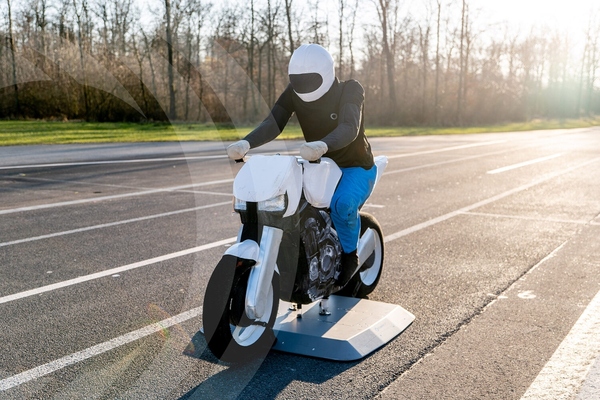






Humanetics will enable the test facility at the University of Michigan to provide access to active safety testing technologies, including robotic platforms.
Humanetics and the University of Michigan (U-M) are collaborating to provide access to active safety testing technologies at the university’s Mcity test facility for joint development of advanced software and robots for new mobility applications.
The tools are designed to make it easier for commercial and academic researchers to conduct comprehensive and accurate evaluations of emerging autonomous and advanced driver assistance systems (ADAS) technologies.
Humanetics will provide Mcity with a variety of its robotic test platforms, which can mimic a range of road users – such as pedestrians, bicyclists, motorbikes and children. In addition, Humanetics will provide training services and TrackBase Connect, a holistic software solution to help manage complex test scenarios and co-ordinate the execution of the different vehicles, traffic lights and pedestrian platforms on the proving ground.
A major goal of the partnership is to fully integrate Humanetics’ dynamic test system into the Mcity testing environment, which will simplify test setup and support running complex tests more quickly and easily.
“The most critical part of testing automated systems is safely dealing with other people on the roads – in cars, trucks, buses, on bikes – and how they use our road network,” said Greg McGuire, Mcity managing director.
“That’s what Humanetics is good at and that’s where we need to be innovative as a state and as a country if we’re going to improve road safety more broadly.”
“The most critical part of testing automated systems is safely dealing with other people on the roads – in cars, trucks, buses, on bikes – and how they use our road network”
Last year, traffic deaths fell slightly in Michigan but remained high at more than 1,100, representing a 15 per cent increase since 2018, according to the Michigan Office of Highway Safety Planning. The National Highway Transportation Safety Administration’s latest projection for 2022 fatalities estimated that more than 42,000 people died on US roads last year, down less than one per cent compared to 2021.
Humanetics’ robots will also be incorporated into Mcity’s safety assessment programme, a two-part protocol for testing the safety of automated vehicles before widespread deployment on public roads.
Mcity is also adding digital infrastructure to the physical infrastructure of the Mcity Test Facility to create Mcity 2.0, a cloud-based, augmented reality test bed for connected and automated vehicles that will be available to academic researchers nationwide. The National Science Foundation is funding the work.
In addition, the robots could be used inside the Mcity Test Facility to explore infrastructure safety applications as they relate to cities of the future.
As part of their collaboration, Humanetics will become an affiliate member of Mcity, a public-private mobility research partnership led by U-M that funds academic research and works with partners to deploy mobility innovations in addition to operating facility.
“By combining the resources and expertise of Humanetics and Mcity, this partnership will accelerate the development and deployment of connected and automated vehicle technologies,” said Mark Westen, president, Humanetics Safety. “This relationship will contribute to ongoing efforts focused on creating a safer, more efficient, and sustainable transportation ecosystem.”
Why not try these links to see what our SmartCitiesWorld AI can tell you.
(Please note this is an experimental service)
How do Humanetics' robotic platforms improve active safety testing accuracy?What role does TrackBase Connect play in managing complex test scenarios?How will Mcity 2.0 enhance testing for connected and automated vehicles?In what ways can robotic test platforms simulate diverse road user behaviors?How does integrating Humanetics' systems accelerate autonomous vehicle deployment?