












 22 - 26 June 2026: Find out more







BUILD YOUR OWN
RESOURCE LIBRARY



Opinions

Smart lighting: enabling smart cities beyond illuminationSponsored by Paradox Engineering

How AI and biometrics are shaping next-generation mobility paymentsSponsored by ST Engineering
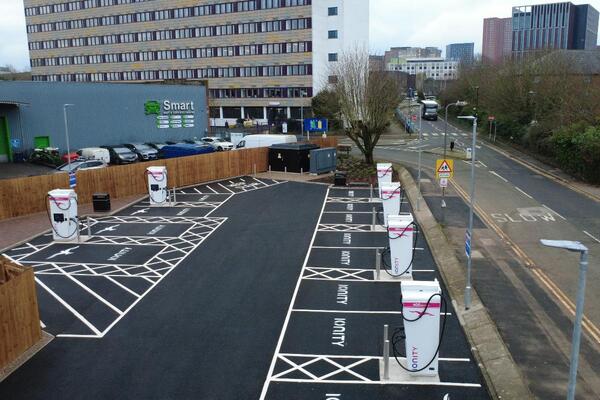
Ionity opens ‘urban’ EV charging site in Birmingham
The EV network provider said the site at Aston is indicative of a strategic shift from motorway-based locations towards its expansion into urban environments.


 At a glance
Who: Ionity; Hubber.
What: Ionity has opened what it describes as its most “urban UK site” to date in Birmingham, offering 12 chargers with its ultra-rapid charging speeds of up to 400kW.
Why: It marks Ionity’s broader expansion into urban environments to make sustainable travel more convenient and accessible for drivers without access to home charging.
Where: The charging site is located on the A4540 at Aston and is 20 minutes’ walk from Birmingham New Street.
Electric vehicle charging network provider Ionity has opened what it describes as its most “urban UK site” to date, located on the A4540 at Aston, Birmingham.
The location is 20 minutes’ walk from Birmingham New Street station and offers 12 chargers with Ionity’s ultra-rapid charging speeds of up to 400kW.
Next-gen ultra-rapid charging hub
Ionity claims the site enable compatible EVs to charge from 10 per cent to 80 per cent in around 15 minutes, entirely on renewable energy. It has been developed in partnership with Hubber, a specialist in high-powered EV charging infrastructure in urban areas. Hubber acquired the site as a derelict car park and redeveloped it as a next-generation, ultra-rapid charging hub.
Ionity said the partnership is indicative of “a strategic shift” from its traditional motorway-based locations. While Ionity has historically focused on enabling seamless electric travel along major road corridors, the new Birmingham location represents the start of a broader expansion into urban environments, making sustainable travel more convenient and accessible for drivers without access to home charging.
“As the UK’s second largest city, Birmingham plays a vital role in the transition to electric mobility”
“The opening of our most urban UK site to date in Birmingham South Aston marks an important evolution of our strategy as we bring ultra-rapid charging into denser urban environments this year,” said Andreas Atkins, UK&I country manager at Ionity.
“As the UK’s second largest city, Birmingham plays a vital role in the transition to electric mobility. By locating high-power charging directly within the city, we’re making sustainable travel more accessible for drivers who may not have access to home charging, while laying the groundwork for many more urban Ionity sites to follow in cities such as London and Manchester.”
The Birmingham Aston South site also further cements Ionity’s presence across the West Midlands, joining existing ultra-rapid charging locations in Dudley, Walsall, West Bromwich, and Coventry. The result is a mix of local and long-distance travel that supports both the local area and commuters.
Harry Fox, CEO & co-founder at Hubber, added: “At Hubber, our mission is to power the future or urban mobility by regenerating underutilised property and removing the friction from infrastructure development.
“We acquired the underused property just four months ago, and now it’s supporting hundreds of EV drivers each day in the centre of Birmingham. We’re proud to partner with industry-leading operators such as Ionity to deliver faster, more reliable charging across UK cities.”
Founded in 2017, Ionity is a joint venture between BMW Group, Ford, Hyundai, Kia, Mercedes-Benz, Volkswagen Group (including Audi and Porsche), and BlackRock’s Climate Infrastructure Platform.
Why not try these links to see what our SmartCitiesWorld AI can tell you.
(Please note this is an experimental service)
How does Ionity’s urban charging site improve EV accessibility in cities?What benefits does ultra-rapid 400kW charging provide to EV drivers?How does Hubber’s redevelopment of derelict sites support urban mobility?Why is Birmingham strategic for expanding urban EV charging infrastructure?How does Ionity’s shift from motorways to urban areas impact EV travel?
Latest City Profile
Latest Urban Exchange Podcast
Latest Special Report
SmartCitiesWorld Newsletters (Daily/Weekly)
You may also like these related articles...
BECOME A MEMBER
© 2026 SmartCitiesWorld
Smart Cities World Ltd, 27 Clements Lane, London, EC4N 7AE