
The technology will enable up to three vehicles to be refuelled simultaneously in the future, including buses, trucks, cars and light commercial vehicles.
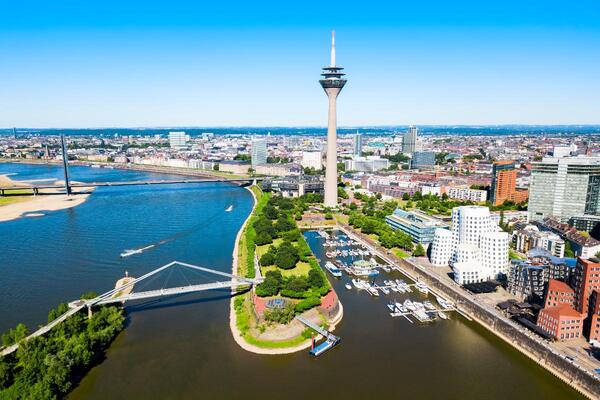
What claims to be the most powerful hydrogen filling station in Europe has been opened in the German city of Düsseldorf by transport company Rheinbahn, Düsseldorf Public Utilities (Stadtwerke Düsseldorf) and public hydrogen refuelling infrastructure company H2 Mobility.
With a daily capacity of up to five tons of hydrogen, the new facility on Höherweg reportedly offers significantly higher performance than conventional stations of the first generation of filling stations in Germany and aims to set new standards in hydrogen mobility.
The patent-pending technology will enable up to three vehicles to be refuelled simultaneously in the future, including buses, trucks, cars, and light commercial vehicles. H2 Mobility, Stadtwerke Düsseldorf and Rheinbahn jointly conceived and implemented the project.
The state government of North Rhine-Westphalia also sees the project as an important building block on the path to decarbonising the transport sector. “In areas that are difficult to electrify, and especially where battery-electric drives reach their limits, hydrogen helps reduce emissions,” said minister of economic affairs and climate protection Mona Neubaur.
“The use of both hydrogen and electric buses in the Rheinbahn fleet and the expansion of the associated infrastructure are a win for climate protection and modern mobility in Düsseldorf”
“With short refuelling times and long ranges, hydrogen-powered vehicles are particularly strong in bus and heavy-duty transport. For fuel cell buses and trucks to actually hit the road, affordable vehicles, a comprehensive network of hydrogen filling stations, and a sufficient supply of green hydrogen are needed. The state is therefore actively driving expansion, supporting the construction of hydrogen filling stations for heavy-duty vehicles and market ramp-up initiatives such as 1,000 Fuel Cell Buses NRW and HyTrucks.NRW as an important contribution on the path to climate-neutral transport.”
The expansion of hydrogen mobility in North Rhine-Westphalia is supported by the state energy agency NRW.Energy4Climate, which is a key driving force behind the development of regional hydrogen ecosystems. The filling station is a key component of the city’s mobility and climate protection strategy. Düsseldorf is pursuing the goal of becoming climate-neutral by 2035.
“The new, extremely powerful hydrogen filling station, which we have launched here in Düsseldorf on Höherweg, shows that we in the state capital are on the right track toward our goal of climate neutrality by 2035,” said Düsseldorf’s mayor, Dr Stephan Keller. “By consistently strengthening public transport, we are offering increasingly better alternatives to private motorised transport. The use of both hydrogen and electric buses in the Rheinbahn fleet and the expansion of the associated infrastructure are a win for climate protection and modern mobility in Düsseldorf. I thank the stakeholders involved.”
Until the Stadtwerke Düsseldorf electrolyser goes into operation next year, the filling station will already be supplied with renewable hydrogen (RFNBO). This comes from a certified source that uses exclusively renewable electricity for H2 production. The ecological footprint of hydrogen mobility at this filling station is thus sustainable from the outset.
“This filling station is a milestone for hydrogen mobility in Europe and represents a new generation of H2 filling stations with more pumps for 350, 500, and 700 bar, larger hydrogen volumes, and significantly more powerful technology,” said Frank Fronzke, managing director and chief operating officer of H2 Mobility. “With our innovative high-performance technology, we enable fast, flexible refueling for buses, trucks, and cars – thus making a concrete contribution to the transport transition. The project demonstrates how collaborative partnerships between business and politics can accelerate innovation.”
The direct supply of locally produced hydrogen from waste energy by Stadtwerke Düsseldorf’s electrolyser from 2026 represents a circular solution and a showcase project for urban sector coupling. The electricity required for this comes from biogenic components of Stadtwerke Düsseldorf’s waste incineration plant. This regional energy cycle significantly and sustainably reduces emissions.
“I am delighted that we were able to develop and implement this project together. What makes this filling station special is that starting next year, it will be supplied exclusively with hydrogen produced locally by Stadtwerke Düsseldorf,” said Julien Mounier, CEO of Stadtwerke Düsseldorf. “To this end, we are building a two-megawatt electrolyser directly behind the filling station. This creates local added value and avoids CO2 emissions during hydrogen transport. Together, we are making a significant contribution to the decarbonisation of Düsseldorf’s mobility sector.”
For Rheinbahn, which already has 20 hydrogen buses in its fleet as part of its decarbonisation strategy, the new filling station in the immediate vicinity of its Lierenfeld depot represents an important infrastructure foundation.
“Together, we are making a significant contribution to the decarbonisation of Düsseldorf’s mobility sector”
“Hydrogen as a drive alternative is a building block of our strategy to reduce CO2 emissions. We are investing specifically in this future technology in order to sustainably transform local public transport in Düsseldorf and the region,” said Rheinbahn board member Annette Grabbe.
“The new hydrogen filling station thus marks another milestone on our path to emission-free mobility. With its commissioning, we are now optimally positioned in terms of infrastructure to refuel our hydrogen buses flexibly and efficiently and to use them reliably in scheduled service.
“The vehicles have already proven themselves in daily use – our drivers appreciate the ride comfort and their performance. Together with our strong partners H2 Mobility and Stadtwerke Düsseldorf, we are actively driving forward the transport transition and noticeably getting closer to our goal of climate neutrality in the region.”
Why not try these links to see what our SmartCitiesWorld AI can tell you.
(Please note this is an experimental service)
How does the new hydrogen station improve refuelling capacity for heavy vehicles?What role does local hydrogen production play in reducing transport emissions?How will hydrogen buses impact Düsseldorf’s public transport decarbonisation?What technologies enable simultaneous refuelling of multiple hydrogen vehicles?How does the station’s renewable hydrogen supply ensure sustainability from the start?