


















BUILD YOUR OWN
RESOURCE LIBRARY



Podcasts

Cities Thriving on Lighting, Episode 2 – Simplicity by design in smart lightingSponsored by Paradox Engineering
Cities Thriving on Lighting, Episode 1 – Lighting as the backbone of the smart citySponsored by Paradox Engineering
Opinions

Transforming indoor public safety with smart sensor networksSponsored by Motorola Solutions
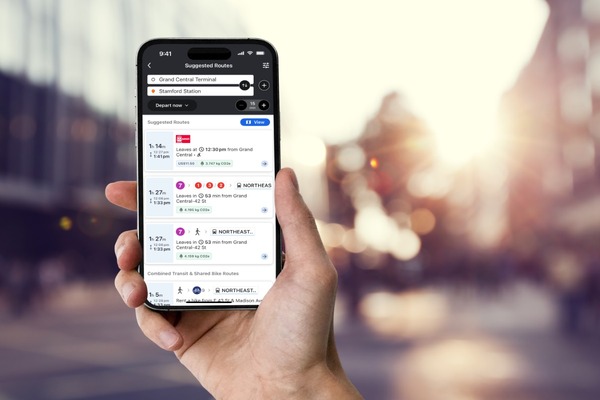
Moovit empowers users to decarbonise their commutes
Moovit app displays GHG emissions of suggested public transportation journeys making it easier for users to make greener sustainable transportation options.


Commuter app creator Moovit is launching the Moovit Low Carbon Commute Project in the US, which enables commuters nationwide to make more sustainable travel choices that reduce greenhouse gas (GHG) emissions.
The reductions are monitored and quantified by Moovit to ultimately generate verified carbon credits.
Low-emission transport options
Moovit displays the GHG emissions of suggested public transportation journeys in its US app. It aims to make it easier for people to choose low-emission transport options like public transit, shared mobility, and walking, helping reduce GHGs from transit trips by helping to change behaviour.
Each qualifying trip taken through the Moovit app may result in emission reductions which, once verified, generates carbon credits, placing the power of climate action directly in the hands of users. One carbon credit is equivalent to one metric ton of CO2e avoided.
“With such a large, engaged user base, Moovit can facilitate collective climate action at scale,” said Nir Bezalel, Moovit’s CEO. “We guide and empower people to choose greener routes. It’s their choices that drive emissions reductions, and in turn, may help corporations offset their greenhouse gas emissions and meet their sustainability goals through verified credits.”
Read More
The Moovit Low Carbon Commute Project is now listed on the CSA CleanProjects Registry, providing third-party validation and adhering to rigorous industry standards. The project was developed in partnership with climate-tech company Greenlines Technology, whose patented Mobility Carbon Engine (MCE) tracks and quantifies emissions reductions for each trip in real time.
Moovit’s solution is grounded in real-time emissions data and measurable transport activity. Through the integration of Greenlines’ MCE into the Moovit app, emissions reductions are calculated whenever an eligible user completes a trip using a lower-carbon mode of transport, compared to its individual baseline emissions.
“With such a large, engaged user base, Moovit can facilitate collective climate action at scale...We guide and empower people to choose greener routes.”
Calculations are based on the estimated transportation intensity of each journey, which takes into account the distance travelled and the emission factors associated with the modes of transport used based on governmental sources and authorised agencies. Trips must meet strict criteria and are independently verified before credits are issued.
By anchoring credits in everyday commuter behaviour, the programme offers:
- Independently verified high-integrity emissions reductions
- Real-time emissions and monitoring
- A scalable, people-powered decarbonisation solution.
“At Greenlines, we’re spearheading a revolution in sustainable mobility by driving transformative behavioural change,” said David Oliver, co-founder and CEO of Greenlines.
“The MCETM, a patented digital Measurement, Reporting and Verification (dMRV) system specifically designed for mobility apps, empowers platforms like Moovit to quantify and report the environmental impact of these shifts while generating revenue through high-quality carbon credit sales.
“For the first time ever, Moovit’s groundbreaking carbon credit project across the USA enables millions of individuals to directly participate in choosing low-emission trips, and effectively aggregate individual and dispersed emission reductions into meaningful impact.”
Why not try these links to see what our SmartCitiesWorld AI can tell you.
(Please note this is an experimental service)
How does Moovit calculate GHG emissions for each public transit journey?What role does Greenlines Technology's Mobility Carbon Engine play in emissions tracking?How are carbon credits generated and verified through Moovit's Low Carbon Commute Project?In what ways can commuters influence corporate sustainability goals using Moovit?What criteria must trips meet to qualify for emissions reduction and carbon credits?Latest City Profile
SmartCitiesWorld Newsletters (Daily/Weekly)
You may also like these related articles...
BECOME A MEMBER
© 2026 SmartCitiesWorld
Smart Cities World Ltd, 37 Lombard Street, London, EC3V 9BQ