






The popularity of Nova stems from it reducing travel time between Tappström and Stockholm City Hall to 30 minutes, compared to about an hour by car or bus.
Region Stockholm is expanding operations of its electric hydrofoil ferry service when it returns to the waters of the Swedish capital after a winter break.
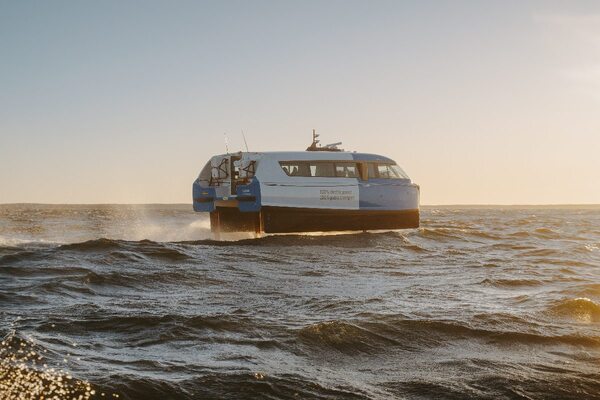
The operators will increase Nova’s service from five days a week to daily operations by May. The Candela P-12 combines electric propulsion with hydrofoil technology and has operated in Stockholm’s public transport system during the autumn.
As the service resumes on 15 April after the ice season, new statistics from Region Stockholm confirm that the vessel is a success both for passengers and the environment.
Nova emits 95 per cent less CO₂ compared to the conventional diesel-powered vessels Lux and Sunnan, which operate the same route, and use 84 per cent less energy per passenger-kilometre.
“We see that waterways in most cities have enormous potential for fast, low-cost, and emission-free transport that can relieve road networks and connect communities. This is just the beginning”
At the same time, statistics show that Nova is extremely popular; most departures have been fully booked – often with long queues. The popularity stems from Nova reducing travel time between Tappström (Ekerö centre) and Stockholm City Hall to 30 minutes, compared to about an hour by car or bus.
The data also shows that Nova attracts more people to travel on water, with a 30 per cent increase in ridership on route 89.
“Nova is drawing commuters to the other vessels as well. That’s especially exciting, since one of our goals is to show that with fast, comfortable waterborne transport, we can get car commuters to switch to waterborne transport,” said Gustav Hasselskog, CEO and founder of Candela.
The Candela P-12 claims to be faster than Stockholm’s fastest diesel-powered archipelago ferries. Thanks to its speed and low wake signature, the vessel is well-suited to both urban areas, where speed restrictions are typically in place due to conventional ferries causing damaging wake, and sensitive ecosystems.
“Demonstrating that the technology is mature and fit for demanding public transport use is important. This is the third generation of our foiling technology, and with lessons learned from producing over 100 leisure vessels, we’re scaling up production to meet demand,” said Hasselskog.
Hasselskog added: “We are incredibly happy that Region Stockholm has enabled us to demonstrate the hydrofoil technology in the city’s public transport. We see that waterways in most cities have enormous potential for fast, low-cost, and emission-free transport that can relieve road networks and connect communities. This is just the beginning.”
Why not try these links to see what our SmartCitiesWorld AI can tell you.
(Please note this is an experimental service)
How does the Candela P-12 reduce CO₂ emissions compared to diesel ferries?What technology enables Nova to achieve faster travel times on water?How does hydrofoil technology minimize environmental impact in urban waterways?What factors contribute to increased ridership on Stockholm’s electric ferry route?How is Region Stockholm expanding the electric ferry service schedule?