







 22-26 June 2026: Find out more

BUILD YOUR OWN
RESOURCE LIBRARY



Podcasts
Cities Thriving on Lighting, Episode 2 – Simplicity by design in smart lightingSponsored by Paradox Engineering
Cities Thriving on Lighting, Episode 1 – Lighting as the backbone of the smart citySponsored by Paradox Engineering
Opinions

Transforming indoor public safety with smart sensor networksSponsored by Motorola Solutions
Greek smart city unveils carbon-neutral green space
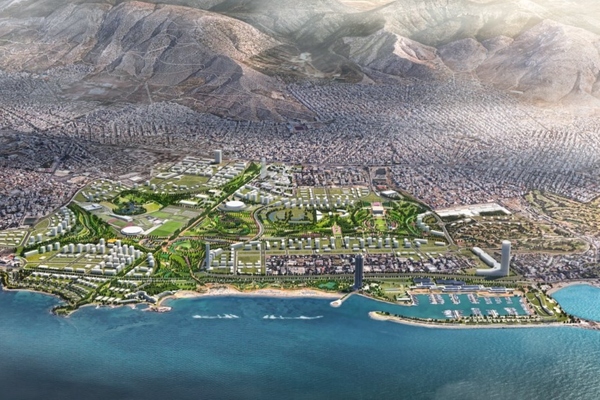
The Ellinikon Metropolitan Park will be Europe’s largest coastal park at more than 600 acres and aims to revolutionise the role parks play in new and existing cities, utilising smart technology for ecological restoration.


The designs for the carbon-neutral green space at the heart of Greece’s smart city, and largest ever redevelopment project, has been unveiled.
The Ellinikon Metropolitan Park will be Europe’s largest coastal park at more than 600 acres. It aims to revolutionise the role parks play in new and existing cities, particularly as connective spaces that utilise smart technology to set precedents for ecological restoration.
€8bn redevelopment
Global design firm Sasaki serves as the master landscape architect for the Metropolitan Park and Coastal Front, which is part of The Ellinikon, Lamda Development’s €8bn redevelopment on the site of the former Athens International Airport. The area was decommissioned in 2001 and has been vacant since the site housed temporary facilities during the 2004 Summer Olympic Games.
In contrast to other European cities, which average roughly 40 per cent public green space, Athens currently offers only about 10 per cent. The City reports Ellinikon will provide a much-needed destination for recreation, outdoor gathering, and immersion in the landscape, and is linked by public transit to serve the larger region.
The park, which is slated for groundbreaking in 2023 with completion of phase one in 2025, will set a new global precedent for ecological restoration and carbon conscious landscape design and aims to transform urban life in Athens for centuries to come.
“Sasaki prides itself on our expertise in designing civic projects that transform cities by creating economic and social value”
As well as Sasaki, the team behind the project includes design and engineering consultancy Arup, Greek architectural firm Doxiadis, environmental design consultancy Atelier10, Fluidity, and engineering and environmental services company, Langan. The design of the park is inspired by Athens’ hillscape and intends to celebrate the connection with the land, proposing strong topographic expressions through the site with weaving landforms creating smaller and larger scale spaces.
In addition, the park’s design centres on ecological restoration, material reuse, and cultural programming that honours the site’s histories while introducing novel experiences in a city that does not have a public park at this scale. The programme will incorporate an impressive diversity of elements including a sculpture garden, an agricultural precinct, an amphitheatre, various outdoor event spaces, a public beach, a marina, a sports district, nature-based play areas, multiple community recreational opportunities, and more.
Read More
“Sasaki prides itself on our expertise in designing civic projects that transform cities by creating economic and social value, enhancing the environment, and providing access to beautiful and resilient public spaces for all. We feel privileged to create a monumental park unlike any other in Athens – one that will last for generations,” said Michael Grove, principal and chair of landscape architecture, civil engineering, and ecology at Sasaki. “We are grateful to Lamda Development and the people of Athens for collaborating with us and for trusting us on this exciting journey.”
Carbon impact tool
As part of a rigorous design process, the Sasaki team developed a series of guiding principles that aim to minimise embodied carbon and maximise carbon sequestration, utilising its proprietary Carbon Conscience tool to assess carbon impact from the early stages of design. By repurposing leftover materials including nearly 30,000 square metres of concrete from the former runways.
The project will be operationally net zero carbon at opening and carbon neutral by 2055. Ecological restoration was another primary objective, with some one million of plants sourced from within Greece and specifically selected to increase biodiversity and establish a regenerative landscape strategy for region.
“We are grateful to Lamda Development and the people of Athens for collaborating with us and for trusting us on this exciting journey”
The design team collaborated with nurseries across Greece to source a palette of native seed mixes, establishing a new regional industry standard for diverse native landscapes. The project is pursuing sustainability certifications for both the landscape and the infrastructure.
The park will be entirely self-sufficient with respect to irrigation and electricity, covering its own needs and completely offsetting its carbon footprint. Sasaki reckons it will contribute greatly to reversing the 70:30 concrete-to-greenery ratio in Athens, ultimately resulting in The Ellinikon consisting of 70 per cent green spaces. It will be connected to the retail district and other areas of The Ellinikon through a network of 50km of walkways, 30km of cycle lanes, and electric vehicle facilities that serve the entire development.
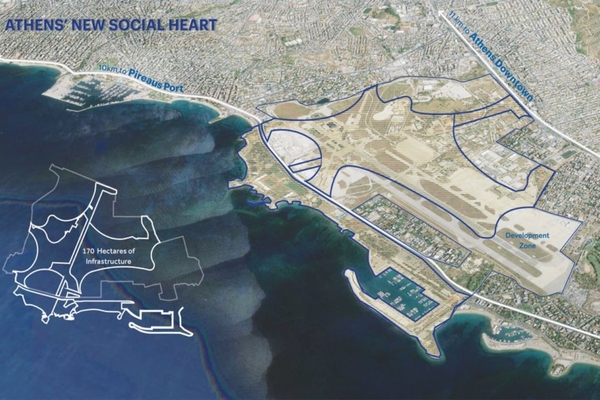
The Ellinikon is being built on the site of the decommissioned Athens International Airport
Why not try these links to see what our SmartCitiesWorld AI can tell you.
(Please note this is an experimental service)
How does the Carbon Conscience tool minimize embodied carbon in design?What smart technologies enable ecological restoration in Ellinikon Park?How will the park achieve operational net zero carbon at opening?In what ways does the park's design enhance urban resilience in Athens?How is native plant biodiversity integrated into the park's landscape strategy?Athensclimate actionCultural spaceEnergy & EnvironmentGreeceParks and green spacePedestrianisationPlanningRecreational spaceresilienceurban space

Latest City Profile
Latest Urban Exchange Podcast
Latest Special Report
SmartCitiesWorld Newsletters (Daily/Weekly)
You may also like these related articles...
BECOME A MEMBER
© 2026 SmartCitiesWorld
Smart Cities World Ltd, 37 Lombard Street, London, EC3V 9BQ