







Shift to electrification supports the City’s net-zero strategy and aligns with the target of transitioning 20 per cent of the City fleet to zero emissions by 2025 and 50 per cent by 2030.
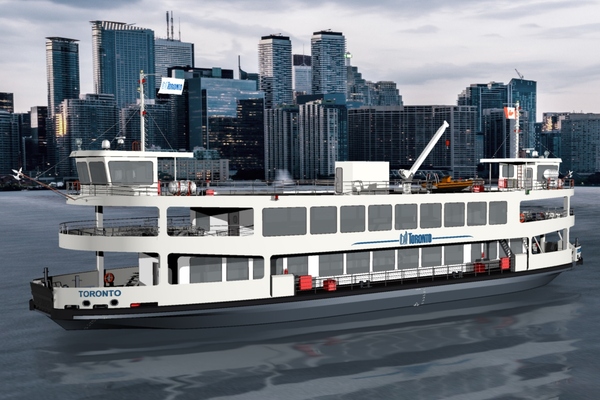
The City of Toronto is recommending a plan to replace Toronto’s current, ageing fleet of ferry vessels with fully electric vessels over a 15-year period.
The report containing the proposal will be considered by the General Government and Licensing Committee (GGLC), later this month.
Toronto Island Park is served by a ferry fleet of four primary vessels and one heritage vessel, which together transport more than 1.4 million passengers and 5,000 vehicles annually to Toronto’s largest park. Although well-maintained, the vessels are between 50- to 100 years old.
This shift to full electrification supports the City’s TransformTO Net Zero Strategy and commitment to accelerate climate action to achieve net zero city-wide greenhouse gas emissions by 2040. In particular, this initiative aligns with the target of transitioning 20 per cent of the City fleet to zero emissions by 2025 and 50 per cent by 2030.
The report recommends a plan to replace four existing primary ferry vessels over a 15-year period. The initial ferry replacement strategy proposed a hybrid diesel-electric technology.
Full electrification of the vessel fleet is estimated to reduce 2,800 tonnes of greenhouse gas (GHG) emissions annually, equivalent to removing 600 cars from the road every year. In addition, displacing diesel fumes, which contribute to air and noise pollution, will provide an improved ridership experience for those visiting Toronto Island.
In November 2021, Toronto mayor John Tory announced a strategy to reduce GHG emissions in the city to net zero by 2040, 10 years earlier than initially proposed
“I support the full electrification of our future ferry fleet. This is the right thing to do for the environment and it is an investment that will ultimately save the City government money,” said Tory. “This is one example of how we are successfully implementing the City’s TransformTO Net Zero Strategy and honouring our commitment to accelerate climate action to achieve net zero city-wide greenhouse gas emissions.”
The report, submitted by City staff in Parks, Forestry and Recreation (PFR), recommends an increase in funding for the additional design and construction of support services required to advance a fully electric design for the ferries and the required shore-side infrastructure. This change, once the full fleet is replaced, will lead to annual savings of up to $1.1m, according to the report. The projected payback on full electrification would be within 20 years.
“I support the full electrification of our future ferry fleet. This is the right thing to do for the environment and it is an investment that will ultimately save the City government money”
The City’s commitment to TransformTO combined with comparable costing for both vessel types, evolving industry trends and available technologies, fleet replacement approaches being undertaken in other jurisdictions and long-term operational savings (fuel cost savings in particular), all reinforce the upfront transition to fully electric ferries.
Although further cost estimates will be undertaken as the project advances, current estimates for the completed designs range between $23m and $25m per vessel. The cost for the fully electric vessels is comparable to hybrid vessels and they will have increased passenger capacity. Additional costs for shore-side infrastructure will be required.
“Our investment payback on electrifying a replacement fleet, based on fuel cost savings alone, is estimated to be $1.1m annually once the full electrification of the fleet is complete,” said councillor Paul Ainslie, chair of the General Government and Licensing Committee.
“This positive assessment shouldn’t shock anyone that electrification is the best ferry fleet consideration.”
Why not try these links to see what our SmartCitiesWorld AI can tell you.
(Please note this is an experimental service)
How will full electrification reduce greenhouse gas emissions annually?What are the projected cost savings from electric ferry operations?How does electrification improve passenger experience on Toronto Island ferries?What infrastructure upgrades are needed for supporting electric ferry vessels?How does the ferry electrification align with Toronto's net-zero strategy?