













 22 - 26 June 2026: Find out more




BUILD YOUR OWN
RESOURCE LIBRARY



Podcasts
Cities Thriving on Lighting, Episode 2 – Simplicity by design in smart lightingSponsored by Paradox Engineering
Cities Thriving on Lighting, Episode 1 – Lighting as the backbone of the smart citySponsored by Paradox Engineering
Opinions

Transforming indoor public safety with smart sensor networksSponsored by Motorola Solutions
School buses give back energy in vehicle-to-grid project
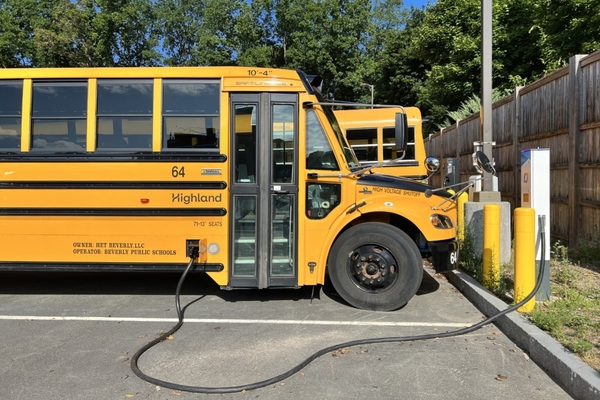
Electric school buses in Beverly, Massachusetts, have put energy back to the electricity grid for more than 80 hours this summer, helping to reinforce the grid when electricity was most in demand.


Electric school buses in Beverly, Massachusetts, have put energy back to the electricity grid for more than 80 hours this summer.
This helped to reinforce the grid during some of the hottest summer days when electricity was most in demand.
Battery system
Municipal and government fleet electrification-as-a-service specialist Highland Electric Fleets worked with technology partners Thomas Built Buses, Proterra, Rhombus, and Synop to activate two Thomas Built Buses Saf-T-Liner C2 Jouley electric school buses, equipped with Proterra-Powered battery systems.
The systems provide more than seven megawatt-hours (MWh) of energy to the electric grid as part of a commercial vehicle-to-grid (V2G) programme with National Grid.
“Fossil fuel-powered buses provide no value when idle. Electric buses, on the other hand, can be used effectively as mobile batteries when not transporting students to provide additional power that supports grid stability and resiliency”
Highland’s Beverly V2G deployment demonstrated the viability of electric buses as V2G resources, across 32 grid events this summer, providing a template to scale the service at additional deployments in Vermont, Maryland, Colorado, California, Virginia and beyond.
“Electric school buses are ideal assets for V2G applications,” said Sean Leach, director of technology and platform management at Highland. “Nearly 500,000 school buses in North America spend most of their time parked.
“Fossil fuel-powered buses provide no value when idle. Electric buses, on the other hand, can be used effectively as mobile batteries when not transporting students to provide additional power that supports grid stability and resiliency. We’re excited to work with top-tier partners to scale V2G programmes and benefits to other communities.”
Utilities can reduce emissions by using electric school buses as distributed energy resources (DER) when energy demand spikes, rather than firing up conventional fossil fuel resources for short periods of time.
Read More
The Beverly deployment is providing essential data that will enable National Grid and other utilities to scale similar V2G programmes in the future for more sustainable energy systems.
This is the second summer that electric school buses in Beverly have served as V2G assets. In 2021, Highland coordinated the same partners to use a Proterra-Powered, Thomas Built Buses Saf-T-Liner C2 Jouley to send around three MWh of energy back to the grid over nearly 60 hours, spanning 30 events.
Technology solutions
The Saf-T-Liner C2 Jouley couples 226 kilowatt hours (kWh) of total energy capacity from Proterra’s battery technology with a Proterra electric drivetrain to offer up to 138 miles of drive range to meet the needs of school bus fleets.
Rhombus Energy Solutions’ 60kW high-powered DC fast charger, certified to UL 1741-SA standards, meet rigorous requirements to ensure safe and reliable operation, and can provide bidirectional charging capabilities for up to five school buses per power control system.
Synop provides fleet managers an end-to-end solution that helps regulate energy on the grid and provides new financial opportunities for fleets. Between charging management, route planning, and energy monitoring and V2G orchestration, Synop automates EV operations at scale and accelerates commercial electrification.
Why not try these links to see what our SmartCitiesWorld AI can tell you.
(Please note this is an experimental service)
How do electric school buses contribute to grid stability during peak demand?What role does bidirectional charging play in vehicle-to-grid systems?How can fleet management software optimize electric bus energy use?What are the environmental benefits of using electric buses as energy resources?How scalable is the vehicle-to-grid technology for other municipal fleets?
Latest City Profile
Latest Urban Exchange Podcast
Latest Special Report
SmartCitiesWorld Newsletters (Daily/Weekly)
You may also like these related articles...
BECOME A MEMBER
© 2026 SmartCitiesWorld
Smart Cities World Ltd, 37 Lombard Street, London, EC3V 9BQ