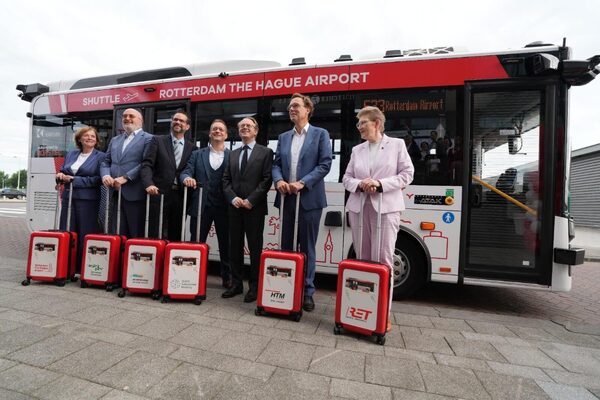








The Karsan Autonomous e-Atak carried its first passengers for Dam Shuttles between Rotterdam The Hague Airport terminal and Meijersplein Metro Station.
Rotterdam Airport in The Netherlands is launching an autonomous bus service with the E-Atak bus from manufacturer Karsan.
Karsan has delivered two e-Atak buses to Dam Shuttles with project partners including the City of Rotterdam, RTHA (Rotterdam The Hague Airport), MRDH (Metropolitan Region Rotterdam The Hague), HTM, and technology companies Applied Autonomy and Adastec.
The Karsan Autonomous e-Atak carried its first passengers between Rotterdam The Hague Airport terminal and Meijersplein Metro Station.
Karsan offers three next-generation technologies: electric, hydrogen, and autonomous. Last year, it signed an agreement with Dam Shuttles to provide public transportation services at Rotterdam Airport and services will commence on 1 August.
“This milestone highlights what can be accomplished when strong collaboration and advanced technology come together to transform mobility”
“This initiative is not only Karsan’s first autonomous bus deployment in the Netherlands but also marks a major milestone in global airport passenger transportation,” said Karsan CEO Okan Baş. “Operating actively in such a strategic location demonstrates that autonomous mobility is no longer a future projection but a real solution of today.”
He added: “We are determined to continue shaping the future of mobility by expanding our operations across Europe.”
The Autonomous e-Atak successfully passed operational and functional safety tests, earning full approval from RDW (Rijksdienst voor het Wegverkeer), one of Europe’s leading authorities. As a result, it claims to officially become Europe’s first RDW-approved full-size SAE Level-4 autonomous bus. “This approval not only reflects the advanced stage of our technology but also demonstrates that we provide solutions meeting international safety standards,” said Bas.
Adastec CEO Dr Ali Ufuk Peker said: “Becoming the first to secure RDW approval in the Netherlands for a full-size SAE Level-4 automated bus is a remarkable achievement, and even more so as this marks Europe’s first deployment of a full-size automated bus carrying passengers in an airport landside environment.
“This initiative is not only Karsan’s first autonomous bus deployment in the Netherlands but also marks a major milestone in global airport passenger transportation”
“Over the years, together with Karsan, we have delivered groundbreaking projects in multiple countries, demonstrating how automated public transportation can move from vision to everyday service. This milestone highlights what can be accomplished when strong collaboration and advanced technology come together to transform mobility.”
Karsan’s Autonomous e-Atak is equipped with numerous lidar sensors positioned at various points around the vehicle. Additionally, it features advanced radar technology at the front, high-resolution image processing through RGB cameras, and thermal cameras for enhanced environmental safety.
These technologies come together to enable Level-4 autonomous driving on a planned route. The vehicle can reach speeds of up to 40km/h in autonomous mode. Karsan said it performs all the functions of a bus driver autonomously, including approaching stops along its route, managing passenger boarding and alighting, and handling navigation through intersections, crossings, and traffic lights, without a driver on board.
Why not try these links to see what our SmartCitiesWorld AI can tell you.
(Please note this is an experimental service)
How does the Karsan Autonomous e-Atak ensure passenger safety autonomously?What technologies enable Level-4 autonomy in the e-Atak shuttle bus?How does RDW approval impact autonomous vehicle deployment in Europe?What operational challenges are addressed by autonomous shuttles at airports?How do lidar, radar, and cameras integrate for autonomous navigation?