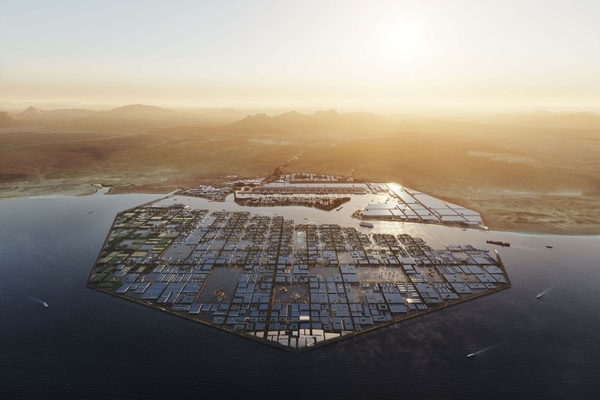




The plant, powered by 100 per cent renewable energy, seeks to create a sustainable water supply for residential, industrial, and commercial use on the Saudi metropolis, which is being built on a greenfield site.
A desalination plant powered by 100 per cent renewable energy is being worked out for the masterplanned Neom greenfield site in Saudi Arabia.
Located in the Oxagon, the reimagined industrial area, its aim is to create a sustainable, abundant water supply for residential, industrial, and commercial use.
To realise the vision, Enowa, the energy, water, and hydrogen subsidiary of Neom, signed a memorandum of understanding (MoU) with Japanese trading company, Itochu, and Veolia, a global leader in water, waste, and energy management solutions.
The new plant aims to meet the water needs of Neom with a production capacity of 500,000m3 of desalinated water per day by project completion in 2025, approximately 30 per cent of Neom’s forecasted total water demand.
Set to produce its early-water in 2024 and aligned with Neom’s commitment to develop a circular economy, the plant will use advanced membrane technology to produce separate brine streams. This will enable Enowa to produce brine-derived products, which will be developed and monetised downstream.
Brine, which is usually considered a waste output of desalination, will be used to produce significant quantities of valuable industrial materials that can be used locally or exported internationally.
“This new desalination plant is one example of the type of sustainable infrastructure and circular economy we are developing to meet our zero-carbon footprint and zero-waste goals”
“Partnering with global leaders in sustainable water solutions is key to Neom’s ambition to become a global benchmark for integrated sustainable water systems,” said Peter Terium, CEO of Enowa. “At Enowa, our vision is to create a sustainable abundance of life’s most essential elements, all in harmony with nature. We will be producing, treating, and reusing water in one of the most water-stressed regions in the world, through sustainable, innovative and integrated solutions.
“This new desalination plant is one example of the type of sustainable infrastructure and circular economy we are developing to meet our zero-carbon footprint and zero-waste goals.”
Brine generated from the desalination plant will be treated by Enowa to feed industries utilising high purity industrial salt, bromine, boron, potassium, gypsum, magnesium and rare metal feedstocks.
This MoU supports Enowa’s ambition to develop advanced green desalination systems and create future water solutions to tackle global water scarcity. “Enowa aims to provide a blueprint for green, sustainable water production, management, and treatment, which can be scaled throughout the world,” said Gavin Van Tonder, executive director of Enowa water sector.
He added: “The technology developed as part of this MoU and used in Neom to provide water could be exported to other countries to tackle global water scarcity.”
Launched in March 2022, Enowa said it is committed to transforming nature’s abundance through design and technology by taking advantage of Neom’s clean slate approach and establishing energy, water and hydrogen production and regulation using circular systems and a sustainable economic framework.
As well as Oxagon, developments within Neom include The Line smart city, a sustainable mountain tourism destination.
Why not try these links to see what our SmartCitiesWorld AI can tell you.
(Please note this is an experimental service)
How does the desalination plant use renewable energy to reduce carbon footprint?What advanced membrane technology enables brine separation and resource recovery?How will brine-derived products contribute to Neom’s circular economy goals?What role does the MoU with Itochu and Veolia play in project success?How can Neom’s desalination technology be scaled to address global water scarcity?