















 22 - 26 June 2026: Find out more




BUILD YOUR OWN
RESOURCE LIBRARY



Construction underway on Manchester mobility hub
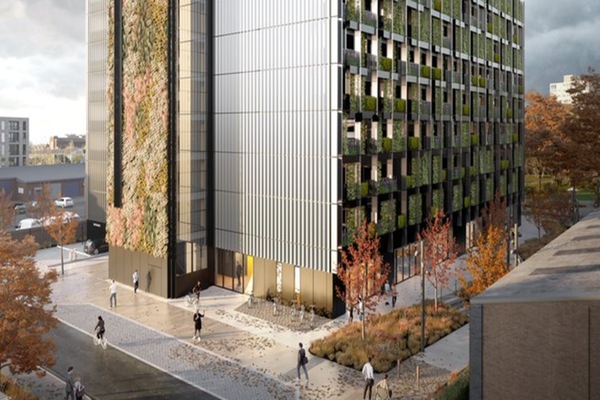
Work has started on site to build what is claimed to be the UK’s first mobility hub in Manchester, which forms part of the Ancoats people-first neighbourhood.


Work has started on site to build what is claimed to be the UK’s first mobility hub in Manchester. It forms part of the Ancoats development, which aims to become a people-first neighbourhood that prioritises streets for people over cars and supports sustainable travel.
The hub forms part of the third phase of regeneration that will transform Ancoats Green as the local community’s “green heart” and unlock 1,500 new homes in the area, including the council’s first “This City” housing project at Rodney Street, and local housing by Manchester Life and other housing partners.
Supporting zero carbon goals
The Ancoats Mobility Hub supports Manchester’s ambition to become zero carbon by 2038, while enabling the city council, Great Places and Manchester Life to deliver homes that will use the hub for parking, reducing vehicle movement around the neighbourhood and allowing more development space to be allocated for active street fronts and community spaces.
The hub is a new concept in urban design, developed in partnership between Manchester City Council and Manchester Life, underpinning the Ancoats’ public realm strategy by prioritising green investment, public space, sustainable and active travel, and individual building design over space for car parking and vehicles. The development is expected to completed by the end of 2024.
“The hub ensures that Ancoats will be not just renowned for regeneration, but for its sustainability – creating a low carbon, green neighbourhood that should be a model for future city centre investment”
“The redevelopment of Ancoats over the last two decades is an exemplar in urban renewal. And rightly so – the neighbourhood is internationally renowned and has been named one of the best places to live globally,” said Bev Craig, leader of Manchester City Council.
“This next phase of regeneration gives us an opportunity to think differently about how our residents occupy and interact with the space they live in. The Mobility Hub is a key part of this – helping to put the pedestrian, active travel and green public space as the focus of the neighbourhood, rather than the car.
Read More
“Upcoming development will deliver 1,500 new homes and the transformation of the local park in this part of our city centre and the hub ensures that Ancoats will be not just renowned for regeneration, but for its sustainability – creating a low carbon, green neighbourhood that should be a model for future city centre investment.”
Vehicle movements around Ancoats will be further reduced by the hub’s delivery centre, which will receive parcels and other deliveries, which will either be collected by residents or transferred to buildings via small electric vans and cargo bikes.
Other community facilities include commercial space for local businesses adjacent to the renewed Ancoats Green to create a third high-quality public space in the neighbourhood, in addition to Cutting Room Square and the marina.
The hub will be equipped with electric vehicle (EV) charging and also provide residents access to car share clubs and cycle hire schemes to reduce the need for vehicle ownership. It will include:
- 150 secure cycle parking spaces with changing facilities for neighbourhood visitors
- 102 electronic vehicle charging points, with potential to increase in the future
- up to 30 spaces for car club/car share schemes
- 406 car parking spaces for residents and visitors – limiting on-street car parking and on-site parking at future development sites (apart from disabled parking)
- 1,370sqm of new public realm, connected seamlessly to Ancoats Green
- more than 1,500sqm rooftop solar panels
- more than 400sqm of green wall and 950sqm of planted façade
- parcel delivery hub for final mile collection point
- space for a new café
- a new commercial unit.
The Mobility Hub has been part funded by Homes England for place-making and off-site infrastructure and Manchester Life. Bowmer + Kirkland is the contractor and Buttress the architect.
The upcoming phase of regeneration builds on the success of previous development by the city council, Manchester Life Development Company and other partners around Cutting Room Square and New Islington Marina.
The council’s This City development at Rodney Street includes 128 new low carbon homes – a mix of one-bedroom apartments to four-bedroom townhouses – 30 per cent of which will be capped at the Manchester Living Rent.
Alongside this project, onsite development in this part of Ancoats includes 68 affordable homes at Downley Drive and 39 affordable homes at the historic Ancoats Dispensary site – both by Great Places Housing Group.
Manchester Life has received planning permission for 190 homes at Jersey Wharf and 118 homes at Eliza Yard and is working on plans for Phoenix Ironworks, which will see a further 256 homes, extensive outdoor areas and space for local creative industries.
All Manchester Life developments will use the H=hub for parking, aside from disabled parking spaces and secure cycle storage at each development.
Why not try these links to see what our SmartCitiesWorld AI can tell you.
(Please note this is an experimental service)
How does the mobility hub support Manchester’s zero carbon goals by 2038?What sustainable travel options are integrated within the Ancoats Mobility Hub?How will the hub reduce vehicle movements and improve community spaces?What facilities does the hub provide to encourage electric vehicle usage?How does the hub’s design prioritize pedestrians over cars in Ancoats?electric vehicleshousingManchesterMicromobilitymobilitynet zeroPlanningResidential buildingsTransport hubsurban space

Latest City Profile
Latest Urban Exchange Podcast
Latest Special Report
SmartCitiesWorld Newsletters (Daily/Weekly)
You may also like these related articles...
BECOME A MEMBER
© 2026 SmartCitiesWorld
Smart Cities World Ltd, 27 Clements Lane, London, EC4N 7AE