

















BUILD YOUR OWN
RESOURCE LIBRARY



New Boston lab uses AI and open data to improve kerb management
Office of Emerging Technology and city partners launch the Curb Lab, aiming to dynamically manage parking and kerb space, reducing congestion in Boston.


 At a glance
Who: City of Boston’s Office of Emerging Technology; Streets Cabinet; Innovation and Technology Cabinet; Office of the Parking Clerk; Office of New Mobility; Citywide Analytics team.
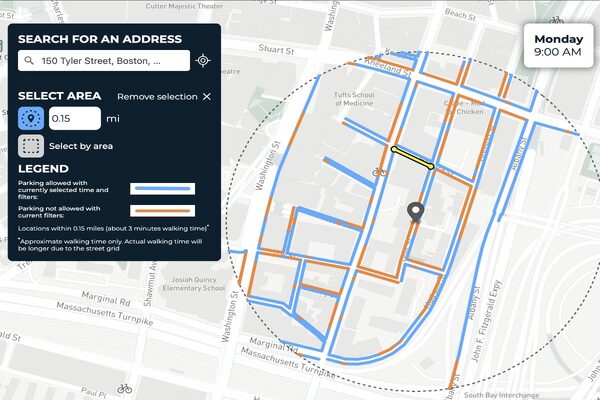
What: Boston has established the Boston Curb (Kerb) Lab to create and maintain a real-time digital understanding of parking regulations and build tools that help residents navigate parking.
Why: It will enable city planners, transportation experts, and policymakers to balance competing demands for kerb space for years to come.
When: This initiative continues Boston’s ongoing kerb modernisation programme.
The City of Boston’s Office of Emerging Technology has established the Boston Curb (Kerb) Lab to create and maintain a real-time digital understanding of parking regulations and build tools that help residents navigate parking.
Powered by modern data tools and artificial intelligence (AI), the new kerb lab will enable city planners, transportation experts, and policymakers to balance competing demands for kerb space for years to come. Project work is already being used to develop reliable tow zone alerts, track food delivery congestion and safety, and build public maps that improve parking accessibility.
Citywide map of parking regulations
According to the City, managing kerb space effectively requires more than new signage or policy changes. Modern advances in artificial intelligence and data tools make a dynamic approach possible, capable of converting 400 years of parking rules and historical information into a citywide map of parking regulations.
With this new publicly accessible database, residents will be able to quickly and reliably answer “can I park here?”. This effort to modernise city operations represents a critical step toward a broader vision of how people experience and perceive the city, aligning with long-term initiatives such Go Boston 2030 and Vision Zero.
“For over 40 years, our kerrb data has lived in disconnected systems that didn’t talk to each other. Through the [kerb lab’s] leadership, we’re finally able to link these systems together”
“Every delivery truck circling for a loading zone adds congestion and emissions. Every unclear sign and process creates unnecessary confusion and safety risks,” said Michael Lawrence Evans, director, Office of Emerging Technology.
“These problems affect how people get around, how businesses operate, and the quality of life in our neighbourhoods. The Curb Lab is our answer to that challenge.”
Read More
This initiative continues Boston’s ongoing kerb modernisation work funded by the US Department of Transportation Smart grant, awarded in 2024. The lab includes partners across the City of Boston, including the Streets Cabinet, Innovation and Technology Cabinet, Office of the Parking Clerk, Office of New Mobility, and Citywide Analytics team.
These teams are putting this digital inventory to work, building systems and harnessing data that will reduce costs over time, help coordinate kerb decisions, and improve efficiency.
“Boston is setting the standard for how cities manage kerb space in the 21st century”
“For over 40 years, our kerb data has lived in disconnected systems that didn’t talk to each other,” said Amelia Capone, director of parking and kerbside management, Office of the Parking Clerk. “Through the [lab’s] leadership, we’re finally able to link these systems together. That means less duplication of work, faster response times to constituent requests, and better internal coordination that will directly improve traffic flow and safety on our streets.”
City permitting tools
The kerb lab uses the kerb data specification (CDS), an open standard developed by the Open Mobility Foundation. CDS makes information about parking rules, loading zones, time restrictions, and other kerb regulations available to the systems residents and businesses already use – mapping apps, delivery platforms, and City permitting tools. It also means other cities can adopt Boston’s approach without building everything from scratch.
“Boston is setting the standard for how cities manage kerb space in the 21st century,” said Andrew Glass Hastings, executive director of the Open Mobility Foundation. “As a member of the OMF’s Smart Kerb Collaborative, they have fully embraced the challenge, and they’re the first to build and deploy these tools at scale using CDS – and they’re making it widely accessible so other cities can follow. What Boston is doing today, cities across the country will be able to do tomorrow.”
Why not try these links to see what our SmartCitiesWorld AI can tell you.
(Please note this is an experimental service)
How does Curb Lab convert historical parking rules into a digital map?How can CDS integration reduce delivery-related kerb congestion and emissions?What metrics will the lab use to measure kerb management success?How will real-time parking data improve accessibility for residents with disabilities?What governance safeguards ensure ethical use of AI and open kerb data?AI and Machine LearningAI CityXchange - Scaling AIAnalyticsBostoncongestionGovernance and CitizenmobilityPolicy MakingregulationRoad
Latest City Profile
SmartCitiesWorld Newsletters (Daily/Weekly)
You may also like these related articles...
BECOME A MEMBER
© 2026 SmartCitiesWorld
Smart Cities World Ltd, 27 Clements Lane, London, EC4N 7AE